
I Cried Through Stag's Leap by Sharon Olds and Without by Donald Hall
My manuscript had been accepted by a publisher when a friend advised me to read Stag's Leap. Here was a Pulitzer-winning book on the same subject--husband of 30+ years falls in love with other woman. Oh great! how could my measly book compare with that, and would everyone think I'd copied her?
But my book was already written. And even though our stories were so similar, Olds told hers her way and I told mine my way, and isn't that how creativity works?
Anyway, I was enthralled by Stag's Leap and yes, it made me cry-- for her, for me. Though I had moved beyond my grief, her book brought up hidden feelings, and it prompted three more poems, which my publisher allowed me to add. It was especially cathartic to write these additional poems. One was "Has He Landed Safely," a poem of understanding about my ex and inspired by the titular poem in Olds's book (which itself was inspired by Stag's Leap wine and its logo of a stag leaping off a cliff).
Her poem begins:
Then the drawing on the label of our favorite red wine
looks like my husband, casting himself off a
cliff in his fervor to get free of me.
and a bit later, she writes:
When anyone escapes, my heart
leaps up. Even when it's I who am escaped from,
I am half on the side of the leaver.
from "Stag's Leap" in the book of the same title, Sharon Olds, Knopf (September 4, 2012)
That poem and so many others in the book made me shout, Yes! Olds connects to the reader through specificity of language and emotional honesty.
How writing helped me (and Donald Hall) heal.
Whether I furiously scribbled, "#&#%#!" on a notepad or sat straight up at three a.m. to scrawl in my journal, writing saved me.
My thoughts were driving me crazy. Writing helped me sort out feelings and make sense of the bomb that had blown up in my life. Sometimes entire poems came out, and sometimes snippets later made it into poems. Some of the real cray-cray talk still sits in my journal, and if I look back (rarely now), I can hardly believe it was me who wrote it.
Donald Hall wrote the poems in Without during the illness and death of his wife, Jane Kenyon. He said, "Writing was the only happy time in my day. It was as if I were doing something about the grief: writing as good a poem as I could. The poems are full of grief and some horror, but it was not grief and horror to write them. It was making them into poems. It was making grief and horror into poetry." (Listen to the whole interview at https://www.youtube.com/watch?v=prrOkStQ640)
His beautiful, honest book made me cry for my mother who'd also died of cancer, and it made me cry for other losses. Again, a cathartic cry. Hall puts us right there in the scene, feeling what the poet feels. Here's an example of how well he brings us into an intimate moment.
From "Last Days"
He asked her, "What clothes
should we dress you in, when we bury you?"
"I hadn’t thought," she said.
"I wondered about the white salwar
kameez," he said -
her favorite Indian silk they bought
in Pondicherry a year
and a half before, which she wore for best
or prettiest afterward.
She smiled. "Yes. Excellent," she said.
He didn’t tell her
that a year earlier, dreaming awake,
he had seen her
in the coffin in her white salwar kameez.
from Without, Donald Hall, Mariner Books (April 14, 1999)
Turning midnight ramblings into poetry.
My writing experience was similar to Hall's: The concentration required to turn my journal notes into "good" poems further helped me get out of my "poor me" ruminations.
I kept writing, editing, and saving poems on my computer with no thought of a book, but with the goal of making viable poems--not too sentimental or desperate, but well-crafted and honest. Some of the poems are angry, others are funny, sad, philosophical, etc., because this is how thoughts and emotions can jump around at times of grief.
After a couple of years, I printed out the divorce poems: about 60! Arranging the best of them into a manuscript got me excited. Wow, the grief had come to something! Call it a work of art or not, it was definitely a "thing" with a life of its own beyond what I went through.
Getting a book published helped me help others.
Writing poems helped me reveal my vulnerabilities. That benefits me but also my readers (or listeners at a reading), who become more emotionally connected to the poems in Untying the Knot than my earlier work. People have even purchased the book for friends going through divorce. I'm certainly not saying I'm a Sharon Olds or Donald Hall--they are masters. But I am saying honest writing speaks to people.
Advice to writers: Don't censure yourself on the first draft.
My advice is not new, but personal experience has shown me that it works: Just let that pen flow! You can rip it up or save it, read it daily or never. Burn it in the stones of your drive like I did with angry letters I wrote, or turn it into a memoir, poetry, or novel, but don't lose the emotion when you edit. Get rid of cliché sentimentality but show us how you feel through actions and images that we can see, hear, taste, touch, and experience.
A friend was reading Untying the Knot while on a cruise with her girlfriends. They admonished, "Why are you reading a book that makes you cry? This is supposed to be a fun trip." She replied, "But it's a delicious cry."
So go ahead and give your readers some delicious feelings--make them shout, Yes! That's what will happen if you open your heart and share.
###
Do you have something say about poetry? An essay on being a poet, tips for poets, or poetry you love? TrishHopkinson.com is now accepting pitches for guest blog posts.
Contact me here if you are interested!
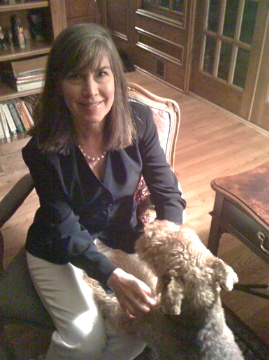
Untying the Knot is available in paperback and Kindle here: http://www.amazon.com/Untying-Knot-Karen-Paul-Holmes/dp/0615998984/
Follow Karen at facebook.com/karenholmespoetry
