
Oft when on my vacant couch I lie (to borrow from Wordsworth) I visualize three diverse voices chart thoughts about my favorite art form. In his verse dedicated to the exemplary W.B. Yeats, a mercurial, nuanced position was taken by W.H. Auden, "Poetry makes nothing happen". I hear Charles Bukowski in his sharpened wine breath, "Poetry is what happens when nothing else can." In the thunderous clamor, Charles Baudelaire intervenes; "Always be a poet, even in prose." Notwithstanding more additions my mind conjures in the epistemology of myriad voices, I aim to delve deeper into the formative juxtaposition of role and use of poetry in the epoch we straddle. The realm of poesy has generated much intrigue and debate: in its form, stylistics, figurative language, historicity and narrative.
Since Plato's suggestion in his Republican that artists must be honorably banished, as they are twice removed from the imperfect reality they mimic, we have come a long way. His descendent, Aristotle, expressed the varied medias every artist works with. In the same vein, poetry is no monolith: multitudes such as anthropomorphic cadences, a crisis, moment of joy, even inertia and nothingness inspire engaging with the art. Again, this is only an indicative, non-exhaustive list.
In answering the question, then, what is poetry? I present two fascinating insights. Emily Dickinson, a solitary woman of letters in her archetypal brevity once reckoned; "If I feel physically as if the top of my head were taken off, I know that is poetry." I particularly chart resonance with William Wordsworth's words, "Poetry is the spontaneous overflow of powerful feelings: it takes its origin from emotion recollected in tranquility." The stylistics of iambic pentameter, heroic couplets, Petrarchan sonnets and free verse (not necessarily in that order) has traversed afar. Today, literary historians admire the restraint and nonconformity e.e.cummings exhibited in his verse. He broke the normative figurines of how a verse must appear on print and a parallel can be drawn to Shakespeare's sonnets being an embodiment of turning Petrarchan sonnets on their head with reference to thematic prototypes.
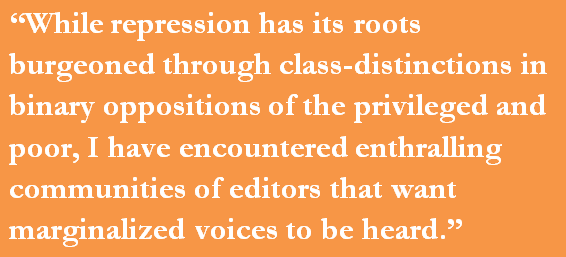
It might be far-fetched to compare the advent of printing-presses and the overall effect it had on the public to re-modifications of our internet era and the thriving topographies of burgeoning literary journals. While codified in comfortable, secular spaces, one can write about social injustices they might experience or bear a testimonial to. The reach of technology also has a rooted problem, though: hyperventilating communication, no conversation. While repression has its roots burgeoned through class-distinctions in binary oppositions of the privileged and poor, I have encountered enthralling communities of editors that want marginalized voices to be heard.
The problem, often, with institutions, and I write from my personal ideological lens, is that they falter at the very premise they build to offer: dreams cannot be sold. In such situations, a community of likeminded folks sharing combined consciousness operates as cathartic.
The question of elitism is again, a binary opposition to pedestrianism: what may constitute as raw to one reader might be against their taste to somebody else. I have had trysts at literary get-togethers where the functionality of repertoire was canonical and also more empirical, in certain stances. In the distinction of these diverse metaphysics, the duality becomes implied - for art is available to produce in the subconscious of a street-dweller as much as an individual sitting in a bungalow with the latest technology in hand.
Being a part of the academia and cherishing our relationship (with interludes of lover's quarrels) I would think that much of contemporary produce is a mirroring of society and maintaining the fabric of individuality. In explaining the utilitarian value of poetics, not to forget, Oscar Wilde did mention; "Art is the most intense mode of individualism that the world has known." and from the volume of a much coveted artist James Joyce, responsible for using the English language something akin (with prior apologies) to dental flossing; "'I will try to express myself in some mode of life or art as freely as I can and as wholly as I can'"
The fabric of contemporary poetics embodies a plethora: from aesthetics of fragmented topographies, to cervical depths of migration and dominancy, issues within confines of drawing rooms and between the sheets, to gliding surfaces of oceans, non-native and bilingual literatures, global warming and climate change, ideals of heterosexuality and homophobia among many others. In Heidegger's Critique of Technology, he brings to the fore a code of systematic, linear understanding that technology propagates. While I'm partial to Heidegger, I am also in awe of artists using words like 'twitter', 'mobile phone' and other commodities unsparingly. There is a multiplicity in arrays of opinion and storytelling that contemporary poetry brings: from unexpected corners around the globe. This, in turn, leads to art being an alternate source of history, as we perceive and see it - in reading diversifications in sets of given circumstances. The scribbling over margins bursts into a sapling and thrives in the broad river of humanities. This, of course, I infer, is the beauty of all literature.
Writing does embody societal and personal frameworks - and is a cloister to express belongingness, or the lack of it, thereof. It is a form of dissent, idiom and idiosyncratic semblance of its source: from a worker in the garage or an aristocrat writing over mahogany.
Bibliography
An Interview with J.M. Coetzee: Lawrence Rainey, David Atwell and Benjamin Madden. modernism/modernity, volume eighteen, number 4. pp 847-853. © 2012. The John Hopkins University Press.
Do you have something say about poetry? An essay on being a poet, tips for poets, or poetry you love? TrishHopkinson.com is now accepting pitches for guest blog posts.
Contact me here if you are interested!