

What makes this conversation especially compelling is how it mirrors the work itself: personal, reflective, and rooted in relationship. Medsker traces the surprising connections between his Disappearing Poems and these new physical pieces, exploring how ephemerality and permanence can answer the same artistic question from opposite directions.
This guest post dives into the origins of the project, the emotional labor behind each object, and the way making physical containers has reshaped his understanding of what a poem is—not just text, but an experience.
Can you describe the Container Poems project — what is a Container Poem, and how did the concept originate?
A Container Poem is an art object built around a theme — every element of the piece supports that theme. The germ of the idea came to me a few years ago when I started thinking about putting poems inside old pill bottles and sending them to friends and family. Unusual containers for an individual poem. About ten years ago I was doing mail art pieces — taking blank postcards, painting them with watercolors, putting a themed poem on the back. One of them I made using water from the Atlantic Ocean, mixed some dirt in, glued seaweed and shells to the painted surface. That was kind of the start. A few months ago it all came together. Since I’m not a traditional visual artist, I wanted to make sure the containers looked semi-professional — at least not embarrassing to show people.
The Container Poems feel like the flip side of your Disappearing Poems project — one releases, one preserves. Did you see them as connected from the start, or did that relationship emerge on its own?
The relationship emerged completely on its own. I started the Disappearing Poems project back in 2017 — and if you want the full story on that project, that interview is still up on this site — but after the first run it ran its course and I stopped. Recently I’ve started it back up, and that idea of ephemerality was still pulling at me. I started thinking deeper about the question — what deserves to be preserved? Why do we preserve art? Why do we preserve beautiful things? Where does that impulse come from?
Can you say more about how the two projects are actually inverses of each other — not just opposites, but mirror images?
Yes — and I think this is the part that excites me most when I think about them together.
The Disappearing Poems begin with an image someone else made. My collaborator takes a photograph, I write a poem in response to it, we post it on Instagram, and then it’s gone. The poem exists briefly in public and then disappears. The audience is anyone who happens to see it. The experience is visual, digital, fleeting. The poem moves outward into the world and releases.
The Container Poems move in exactly the opposite direction. I begin with a relationship rather than an image. I make a physical object, put the poem inside it, and it goes to one specific person. No one else sees it. The experience is tactile, private, permanent. The poem moves inward — toward a single person — and holds.
So in the Disappearing Poems the image comes first and generates the poem, and the poem dissolves into the world. In the Container Poems the relationship comes first and generates both the poem and the object, and the object preserves them together.
What I find interesting is that both projects are trying to solve the same problem from opposite ends — how do you make a poem feel necessary? In the Disappearing Poems the answer is: make it temporary, make people catch it before it’s gone. In the Container Poems the answer is: make it so specific to one person that it could never have existed for anyone else. Ephemerality and permanence as two different answers to the same question.


The first container I gave to my wife. I wrote a poem on origami paper, rolled it up, tied it with twine, and placed it inside an empty bottle of my mood stabilizer medication. The poem was about how my wife helps my mental health. I put the whole thing inside a small paper bag like you’d get from a pharmacy. I hand-delivered that one.
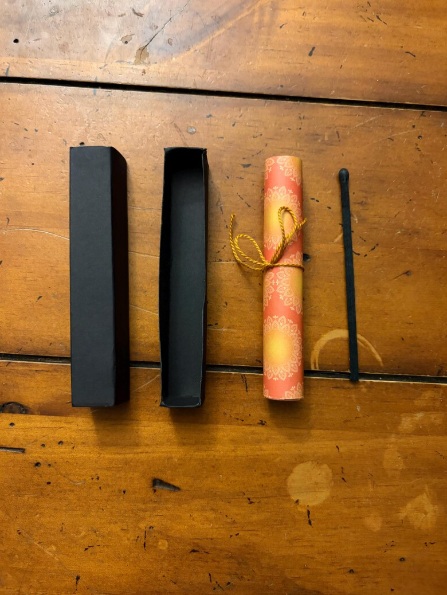
The second container I gave to a good friend. She was showing me pictures she took on a recent trip to Nova Scotia — the sun coming up over a rocky cliff, looking like fire. We were talking about which element we felt most pulled toward. She said fire. So I wrote a fire-themed poem on orange flame-patterned origami paper, rolled it up, tied it with a gold ribbon, and placed it inside a thin black matchbox with a single match still inside. I liked that touch — in its own way it becomes both a Container Poem and a Disappearing Poem, should you choose to burn it.
The objects you’re creating engage multiple senses — touch, smell, sound, sight. How consciously do you think about the sensory experience of the reader before the poem is even read?
It’s become very conscious, though it didn’t start that way. I think about the moment of opening — what does the person’s hand feel first? What do they smell? Is there a sound, like a match rattling in a box? The poem itself almost becomes the last thing they encounter, which I love. By the time they unroll it and read it, they’ve already had a full physical experience. The poem lands in a body that’s already been activated.
How does knowing the specific recipient shape both the poem and the container itself?
Completely and entirely. The pill bottle only works because I know my wife’s role in my life. The matchbox only works because I know my friend and what fire means to her. The container and the poem grow out of the relationship — they couldn’t exist without it. In a way the recipient is a co-author, even if they don’t know it yet. Once I begin taking commissions I’ll provide a detailed questionnaire so I can get to know the person receiving the piece. The poem and the container should be intimately tied to the receiver, if I’ve done my job correctly.
How has making physical objects changed your understanding of what a poem actually is?
I’ve been thinking a lot about explanation versus direct experience. With my poems lately I’ve been moving away from work that describes feelings or objects, and toward something more akin to chants, instructions, songs — all of these things at once. That places the text in the world of a script to be performed, brings it off the page. In a way it makes the words less precious, because the experience of speaking or singing or chanting them becomes the most important thing. Making objects has made that more literal. A poem is something that happens to a person. And really, the page was always just one kind of container.
What has surprised you most about this project so far?
Two things. First, how difficult it is to do it correctly. In writing it’s easy to erase what you don’t like and start without a plan. With art objects there have to be outlines, double and triple-checks on technique. That’s why the first two pieces took so long.
Second — how emotionally demanding the process is. I thought it would be more craft-focused: choose the container, write the poem, assemble the object. But every piece has involved a kind of reckoning with the relationship it’s made for. Making the pill bottle poem for my wife was one of the most vulnerable things I’ve done as an artist. I wasn’t expecting that.
What’s next for the Container Poems?
I’m currently working on an earth-themed piece using handmade seed paper — the container itself will be plantable, so the poem literally becomes part of the earth after it’s read. I’m also interested in pushing the technology angle — embedding NFC chips or non-paper QR codes into the objects so they carry a digital layer alongside the physical one. The project keeps expanding in ways I didn’t anticipate.
It sounds like you’ve been doing this intuitively — but where might this fit in the broader history of artist books, mail art, Fluxus?
Honestly, I came to most of this backwards — I was doing the thing before I knew there was a tradition for it. The DIY spirit has been with me since I was a teenager in the Anchorage punk scene. I’ve been making zines since 1994, off and on — cutting and pasting, photocopying, stapling things together and sending them out into the world. About ten years ago that energy started shifting. I still run Twenty Four Hours Press and make zines irregularly, but I found myself drawn toward mail art — making objects and sending them directly to specific people rather than broadcasting to a general audience. That underground ethos of getting something real into someone’s hands, no gatekeepers, no intermediaries — that never left me, it just got more personal.
So when I look at the mail art movement, Ray Johnson mailing collages and strange fragments to artists and strangers through what he called the New York Correspondence School — using the postal system itself as his gallery — I recognize something familiar. Or Yoko Ono’s Grapefruit, a collection of instruction pieces that are really scores for experiences rather than descriptions of them. I recognize myself in both of those impulses. I was working in that neighborhood without a map, which is probably both my limitation and my freedom.
What does the commission process look like, and how do you price something so intimate and labor-intensive?
I’ll start with a detailed questionnaire — about the recipient, the relationship, significant themes, meaningful objects, elements they’re drawn to. I want to understand the emotional landscape before I touch a single material. As for pricing — I’m still figuring that out. The labor is significant, the materials relatively modest, but the intimacy is what’s hardest to put a number on. What you’re commissioning isn’t just an object — it’s a relationship made physical.
You’ve worked extensively with constraint-based poetry — the Medskerpedia project being the most ambitious example. How does the Container Poems project relate to that history?
The constraint here is the relationship itself. With Medskerpedia the constraint was external — encyclopedia entries, poetic forms, the alphabet running backwards over four years. With Container Poems the constraint is intimate — the container has to be true to the person, the poem has to be true to the container, everything has to cohere or the whole thing falls apart. It’s the most demanding constraint I’ve worked with, because there’s no hiding behind formal architecture. The only rule is: does this feel true to this person?
These first pieces have all been for people close to you. Now you’ll have to make a Container Poem for someone you’ve never met.
It’s daunting. But the questionnaire is what will make it possible — it really is a collaboration between me, the person commissioning the poem, and ultimately the person receiving it. Knowing someone doesn’t have to mean years of friendship. It means asking the right questions and really listening to the answers. In some ways a commission for a stranger might be the purest version of the project — making something genuinely intimate purely from what someone chooses to share, no assumptions, no history, just the information in front of me and the work itself.
The Container Poems are deeply personal gifts. Do you worry about the recipient not fully understanding what they’re receiving?
That’s something I think about. Not everyone has a relationship with poetry or art objects — some people might open the matchbox and just see a piece of rolled up paper. But I think the physical experience does some of the work before the reading even begins. If I’ve done it right, the object creates curiosity and reverence before the poem is even unrolled. And honestly, even if the recipient doesn’t fully understand it intellectually, they’ll feel that someone made something specifically for them. That lands differently than anything you can buy.
You’re a poet who also runs a small press. How does the Container Poems project relate to your broader thinking about how poetry reaches people?
Twenty Four Hours Press has always been about getting work directly into people’s hands — small runs, no waiting for institutional permission. The Container Poems take that even further. There’s no press run, no distribution, no intermediary of any kind. It’s the most direct version of what I’ve always believed: that a poem should reach a specific person in a specific moment and mean something to them specifically. Everything else — journals, collections, readings — is wonderful, but it’s still broadcasting. The Container Poems are a direct conversation.


If you like this post, please share with your writerly friends and/or follow me on Facebook, Blue Sky, or Instagram. You can see all the FREE resources my site offers poets/writers on my Start Here page.