
The first time I asked to study blackout poetry, I was an undergrad at Salem College. I'd asked the director of my Creative Writing program to do my honors independent study on it.
I remember sitting in her office on the second floor of Main Hall, fiddling with her crocodile shaped staple remover. I kept turning it around in my hands and pressing my fingertips against its sharp teeth, unable to meet my professor's eyes.
"We would have to hire a consultant or professor, probably from California," she said, while googling. She wasn't familiar with blackout poetry. Not many people are, even today.
Blackout poetry refers to poems created by covering a source text with marker, paint, thread, etc. in order to obscure a majority of the text, leaving just a few words readable, forming a new poem, like Austin Kleon's Newspaper Blackout and Isobel O'Hare's all this can be yours. We often confuse blackout poetry with erasure poetry; however, the latter requires an author to remove portions of a preexisting text to create a new poem.
Actually, let me rephrase, not many people in academia are familiar with it. Outside of academia, blackout poetry is thriving. On Instagram, there are over 154,000 posts tagged #blackoutpoetry and Tik Tok videos under the same hashtag have been viewed almost 800,000 times. Even my high school English students keep begging to have a blackout poetry day in class too, even though most of them hate traditional poetry - reading or writing it.
Even though I didn't end up writing my undergrad thesis on blackout poetry, I didn't let it go. I kept making my own blackout poems, even going so far as to create an entire Instagram account devoted to blackout poems made out of people's Tinder bios. When it came time to do my Master's thesis at Texas Woman's University, I tried again to convince my professors that blackout poetry was worthy of academic study.
This time a few years had passed during which blackout poetry had gained significant popularity due to the eruption of blackout poems following the #MeToo movement and the political upheaval following the election of Donald J. Trump. But that wasn't what convinced my advisor.
"The architecture teacher here is using blackout poetry to teach her students about the importance of bricks." I told my advisor over Google Hangouts. I was teaching at an academic summer camp for gifted middle school students. I only had one day off a week, Sunday, and that was devoted to thesising, so I was sitting outside with headphones crammed in my ears almost but not quite arguing with my advisor.
"Huh," she said, sitting back and adjusting her overly large turquoise glasses. "Really?"
Blackout poetry has become pervasive in education, particularly in middle and high schools. The phrase "blackout poetry lesson plans" generates over a million hits on Google in .050 seconds. Teachers, and not just English teachers, use it frequently to engage students in poetry. Blackout poet and teacher J.M. Farkas suggests that with blackout poetry students "seem less intimidated by the process of erasing, as opposed to new writing." The architecture teacher's students loved making blackout poems and absorbed the lessons that went along with the poetry well.
The fact that an architecture teacher was using blackout poetry to teach about bricks at a GT summer camp stumped my advisor. After all, how often do we hear about teachers outside of the English field using poetry in their classes? Not often. But blackout poetry is changing that. It is not only accessible to those who don't consider themselves poets in a traditional sense but also for some it is easier to write than the other forms because of how our society has evolved.
In a world of social media and constant remixing of trends, content, and ideas, Adriane Quinn argues that erasure and blackout poetry "show us how much of our world is made up of redaction: how everything we see, touch, read, wear, and nibble was created through selection by cutting, refracting, withholding, reducing, commercializing, and making smaller from a wider, more complex strata of possibilities." Blackout poetry is a form of poetry that suits the needs and lifestyles of today's readers and writers.
However, academia has not fully embraced blackout poetry yet. As a result, I realized in order to write about it for my thesis, I was going to have to convince others that blackout poetry is a legitimate form of poetry and deserving of study. I knew my anecdote about the architecture teacher would not work for everyone. So, I decided rather than writing just an analysis of blackout poetry, I would create a digital open access histography: This Ocean of Texts: The History of Blackout Poetry.
I divided the project up into four sections: "What is Blackout Poetry?," "Academic Coverage," "The Politics of Blackout," and "The DIY Movement." The first provides an introduction to the project including an analysis of how blackout poetry is different from erasure and a brief timeline of the history of blackout poetry going back to the 1920s. The section on academia provides a substantial literature review of publications that covered blackout and erasure poetry. The other two sections focus on the two movements that have sprung up within the past twenty or so years, focusing on how blackout poetry has been used to tackle United States political upheaval and how it has moved out of traditional poetry communities and into the hands of community members who did not previously consider themselves poets.
While This Ocean of Texts: The History of Blackout Poetry only currently addresses the history of the form in the United States, I hope to continue to grow it and add to it. Blackout poetry will only become more popular I think, and I am excited to document it as it does.
Do you have something say about poetry? An essay on being a poet, tips for poets, or poetry you love? TrishHopkinson.com is now accepting pitches for guest blog posts.
Contact me here if you are interested!
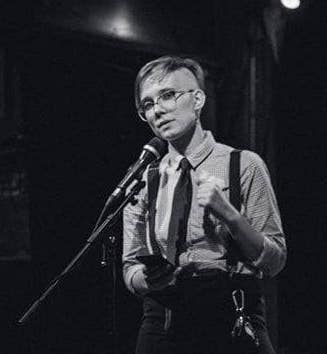

Emily Ramser is a queer activist-teacher-scholar-poet living in Denton, Texas where they write, collaborate, and perform with the creative collective Spiderweb Salon. A graduate of TWU and Salem College, Ramser currently teaches AP English and yearbook at Braswell High School while recording the history of blackout poetry and advocating for the rights of LGBTQIA+ students. You can find more of their work on their website, authoremilyramser.wordpress.com and on Twitter at @RamserisReading.