
Content Warning: physical abuse, reference to eating fish
“…do not paint too much after nature. Art is an abstraction; derive this abstraction from nature while dreaming before it, and think more of the creation which will result than of nature.” —Paul Gauguin
Existence is infinite and ineffable, but poetry creates a cup to hold it. The cup shapes the story; the story shapes the cup. In the shaping, the writer and the reader are often surprised.
The process of telling the infinite story, telling the truth, is as sacred as a baby—even more so since so many of us have been silenced—but it’s the job of the poet to raise that baby, to craft it. To employ another metaphor, the story is a huge fish, which, after being snagged, is then crafted into a manageable piece of sushi.
There are many methods to contain the infinite story, but the first convention that comes to mind is form. Writing a sonnet, ghazal, pantoum, or villanelle, etc. is one way to wrangle the enormous tale and also to ignite the discovery and music that imbues the poem with feeling. Some writers—Jericho Brown’s duplexes come to mind—tailor their own forms, turning the tables and crafting the form to the content, then adhering to their own form.
The best way to learn how to write form poems is to read form poems—old ones and new ones. I like to study the way writers adhere to form and break it. In general, I like the poem to control the form, not vice versa. In other words, I enjoy reading a poem and asking, Wait a minute, is that a sonnet? To see repetition and ask, Wait, is that a pantoum? Spying the form is delightful, tapping into the long history of poetry. Sometimes, I set out to write a form poem, and the form is barely apparent at the end, but the repetition, rhyme, or length haunt the poem, lending it gravitas.
Let’s look at a sestina I wrote and analyze its genesis:
Sister Sestina
Hard to believe,
once, all I wanted
was to be pretty,
to be loved.
My older sister’s body
was made of men,
desire-drunk men
gilded with belief
in the pull-tide of her body.
I saw it so often, I wanted
it too. I was not loved,
only beaten, but I wanted to be pretty.
I knew I’d never be pretty,
never unravel men,
pull their love
from their throats, make them believe
what they wanted
was the ruby-heat of my body.
I was told a woman’s body
was a sting, to be pretty,
a scorpion, to be wanted
by the ember-eyes of men—
a witch-made safety. I believed
what I was told about love,
but it bought me no love,
no light in the hollows of my body.
Back then, my sister believed
our mother’s incantations—be pretty,
let your scent ensorcell men.
To be wanted
was all she wanted
Maybe because we were beaten, love
became the breath of men.
When our beaten bodies
lit them with panic, we felt pretty,
believed.
We didn’t want to be sisters, only bodies,
safe from the whip, loved, pretty.
Men would split us like fruit. Believe us.
–Dion O’Reilly, first published Marin Center Anthology
I started with over a page of words and phrases, pasted on my first draft, from a 400-page word bank I have compiled from my reading, my passing thoughts, and what I see and hear in the world. Of course, because the thorny issue of abuse, beauty, and power vexes me, it appears frequently in my word bank. My early indoctrination around attracting the male gaze must have been on my mind that day because I added references to it—from my word bank— to my first draft.
At some point, I pasted this thought on my document:
hard to believe: once, all I wanted was to be pretty. To be loved.
I can look at my Google doc history and see that, over a period of about ten minutes, I cobbled together this stanza from my word list, which, as you can see, I later changed:
hard to believe,
once, all I wanted was to be pretty.
To be loved.
My sister’s body seemed to be made of the faces of men
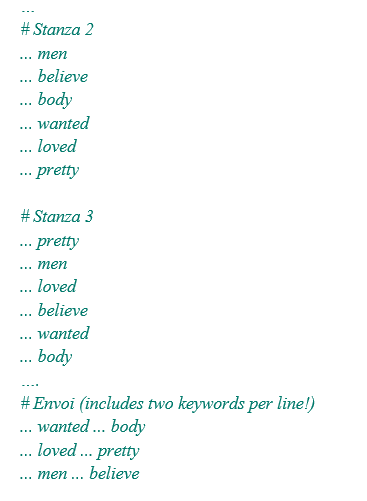
I saw six potential line-ending words, so I went to an online sestina generator and filled in believe, pretty, loved, body, men.
Here is what the generator gave me—the line endings in sestina order. I won’t include all the stanzas here :

Here are parts of an early draft, taken from my Google doc revision history, with fleshed out lines and some edits made on the fly.
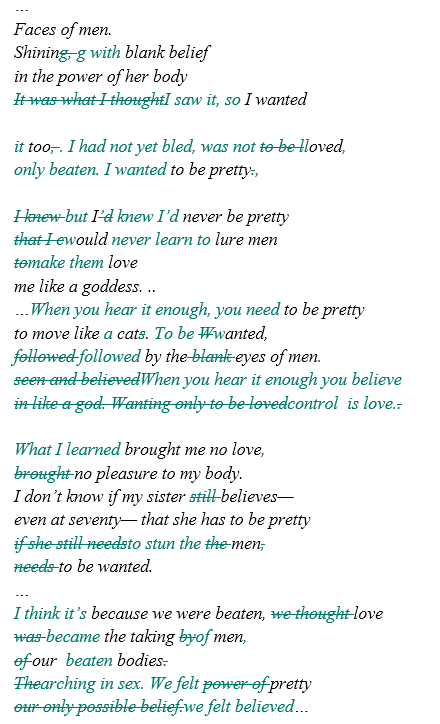

Some ideas in this draft, like the references to menstruation and control, albeit powerful, were not vivid enough and did not work in support of the discovery, while images like the following were added later:
desire-drunk men
pull-tide of her body
unravel men,
pull their love from their throats,
ruby-heat of my body
a woman’s body was a sting, to be pretty, a scorpion, to be wanted by the ember-eyes of men— a witch-made safety.
no light in the hollows of my body.
our mother’s incantations
let your scent ensorcell men
These added images are vivid, but more importantly, they build a description of a perverse— almost superstitious—idea about female power that pervaded my childhood. Some of the added diction came intuitively, some from searching my word bank, and some came to me as I continued to read other writers, think, and study.
This poem went through many drafts, but the basic order of operations was the following:
- I intuitively pulled from my extensive word bank, creating about a page of possible words and phrases, much of which landed on the editing room floor.
- I spied a possible form—a sestina.
- I established the line endings with a generator (of course, a generator is optional, but I find them fun and helpful)
- I fleshed out the lines, working toward a narrative idea.
- I developed my imagery to be more vivid AND in support of a larger concept— the complex attitude toward female beauty and its relation to power and subjugation.
Some poems want to live in form. The challenge is to be sensitive to the poem’s needs. Then, in the process of sharpening the imagery, a strong discovery may emerge, and the overwhelming personal experience is contained in an ancient vessel, or, as we love to put it, a craft.
For more on the sestina, here is a wonderful segment from Poetry Unbound.


- Facebook: @dian lissner o’reilly
- Twitter: @dionoreilly
- Instagram: @deepobrain
- https://hivepoetry.org/