
Wallace Stevens, one of my favorite poets, published his first book of poetry, Harmonium, when he was 44 and didn’t publish another collection until Ideas of Order, when he was 57. He went on to publish five more collections of poetry.
E. B. Moore published her first chapbook of poetry New Eden: A Legacy (Finishing Line Press, 2009) at age 67. She has since published four novels.
Monica McAlpine published her first poetry collection, Winter Bride (Main Street Rag Press), in 2021. The book was a finalist for the Sheila Margaret Motton Book Prize of the New England Poetry Club, though that’s less important to me. What IS important, is that she was 80 at the time.
I published my first book of poems, The Sea is My Ugly Twin (Finishing Line Press, 2018) at age 62, and in 2026, at age 69 ¾, I’ll publish my fourth poetry collection, Stroke, Stroke (Finishing Line Press). I attribute a slightly-more-advanced age of first publication to my own earlier laziness as a submitter—grad school, a teaching career, parenting, laundry, etc. But I don’t want to talk here about the reasons people publish later in life—I want to talk about the benefits.

Another plus as an older poet is that I’m no longer operating under my grad-school-days misconception that I would someday be a “famous” writer. I was never good at math, but I should have figured out those percentages much sooner than I did. I’ve since made peace with my lack of recognition—no pressure, no ladder-climbing, no hobnobbing unless I feel like it, no jetting off for another one-night reading (she says, pretending she wouldn’t just ADORE that)—and I can simply enjoy and appreciate the act of writing itself.
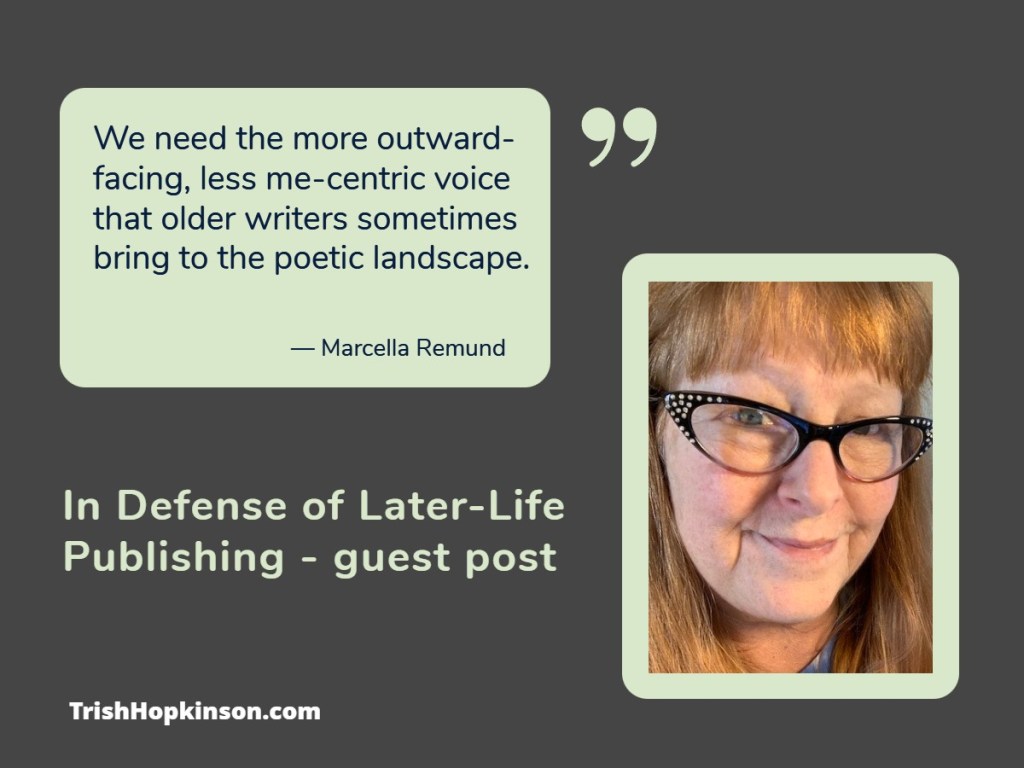
One of the most important things about older poets is that they add perspective to the depth and breadth of poetry. I’m glad for the passion, idealism, energy, and unabashed in-your-faceness of many younger poets’ work. We need it. But we need ALL the voices. We need the less-panicked historical perspective, the longer, sometimes more comprehensive, panoramic view. We need the more outward-facing, less me-centric voice that older writers sometimes bring to the poetic landscape.
Finally, the best thing about publishing later in life is that we older writers get to fly in the face of the “too late” doomsayers. When I had a stroke in 2012 (the subject of my forthcoming book, and note that ALL of my books were published AFTER this game-changer), doctors, therapists, and others told me that whatever function I didn’t get back after a year was probably gone for good. Yet I’m STILL experiencing tiny recovery milestones thirteen years later. I’m not suggesting that younger poets should wait around for the gerification (older poets make up words willy-nilly) of their poetry. By all means, publish as much as you can now—the world needs as much poetry as it can get right now. I’m suggesting that if you’re an older poet, you should get those poems and manuscripts together and submit them because seriously, your voice matters, and it is NEVER too late.

If you like this post, please share with your writerly friends and/or follow me on Facebook, Blue Sky, or Instagram. You can see all the FREE resources my site offers poets/writers on my Start Here page.