


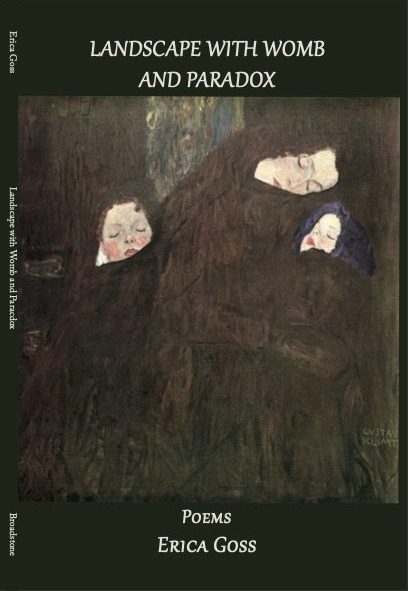
Landscape with Womb and Paradox, Erica Goss’s second full-length poetry collection, was published by Broadstone Press in January 2026.

Armed with those lessons, I thought my second collection couldn’t possibly take as long as the first. After all, I was a seasoned writer who’d published a chapbook, Wild Place, and a book of writing exercises, Vibrant Words, as well as Night Court. Surely, I would benefit from the lessons I’d learned sending my first book out.
I was wrong. My second book was just as much work as the first, and followed a similar path: early versions, different titles, multiple rejections, and painstaking reworkings. On the first pass, I chose, carefully I thought, from the poems I’d written after Night Court’s publication, crafting a story about motherhood, mental health, moving from California to Oregon, the environment, and world events.
Looking at early drafts, however, I can see that these versions weren’t focused enough. Still fresh from my move, I tried to force the manuscript into a book about place, but even though many of the poems are place-based, it refused to cohere around that theme.
Gradually, it dawned on me that every poetry collection possesses its own personality, motivations, and twisty logic. To paraphrase Kahlil Gibran’s poem, “On Children:” “Your books are not your books. / They come through you but not from you, / And though they are with you yet they belong not to you.” I realized, belatedly, that I was not the boss of this book but its guide; my job was not to order the poems but to allow them to find where they belonged.
A poetry manuscript is a flexible entity, open to additions and subtractions. Every once in a while, a poem I’d just written would find a place in the structure I’d created for the book. This happened with what would become the title poem, “Landscape with Womb and Paradox,” which I wrote years after many of the other poems. That poem was the narrative’s lynchpin. Once I’d written it, the book finally knew what it was about: transitions, illustrated by the configurations I’d tried to force it into: moving, children growing up, the world changing around me, and nature.
This was in early 2024. I’d been sending the book out since mid-2021 under a series of tepid titles. Now I had a title that stood out. I sent the final draft to Broadstone Books in May 2024 and received an acceptance in July. The world of publication is slow, however, and the book wasn’t published until January 2026.
The most important lesson I learned from the second book was that, like the first one, this book needed time to come together. There were periods of intense work followed by fallow stretches, and both were equally important to the book’s development. It might have taken years, but those years were a necessary part of the creative process.
Landscape with Womb and Paradox
On a black sand beach
I lost my virginity.
How I bled with relief. I finally
understood the shapes of things:
as maiden, I was a trophy
to be won. Now I could never
be caught again, never again
broken into for the first time.
Some bodies are shared, some stolen.
I had not yet inhabited my body
in such a way, even though I’d
passed first menses, that time
of increasing tremors, of coarse hairs
breaking the skin, and the dawning
of certain terrible truths: history
is written by the winners and
you will bear children. It was
a matter of connecting the dots:
my loss was someone’s gain.
To be a woman is a paradox,
bleeding oneself open for another’s
use while desire peaks at mid-cycle.
My youth was a canvas turned
to the wall. The vanishing point
beckoned. I had no choice
but to draw myself forward.


Landscape with Womb and Paradox is available from Broadstone Books.
If you like this post, please share with your writerly friends and/or follow me on Facebook, Blue Sky, or Instagram. You can see all the FREE resources my site offers poets/writers on my Start Here page.