

My version of the poem had the same premise to start with, but rather than the lavishness of Georges’ poem, it spoke of layers of defensiveness against a world that seemed to be attacking and out to get me. I remember the other two connections I’d made (aside from the poem) vividly. One was a mental health podcast episode by Dr. Caroline Leaf; the other was my own fabrication of a visualization exercise I’d used during the meditation I start my writing workshops with. In this visualization, I asked the workshop participants to imagine their bodies building defense layers.
And so, the first draft of my poem came to fruition, and I was quite pleased with it. There was a strangeness to my work; textures that felt simultaneously accurate and unusual. The poem made me uncomfortable in all the right ways. Yet I felt that something was off—it wasn’t close enough to the uncanny experience of being seen as a commodity or a number and trying to build back my individuality, my softness included somewhere in the mix.
I sent it out with a few edits at first, and although it came close a couple of times, it didn’t get picked up anywhere for the longest time. At the time of writing (ironically, after a huge overhaul, as you’ll see), someone has just accepted the first iteration of it. That doesn’t stop me from (hopefully) elevating it for my next collection.
Step 1
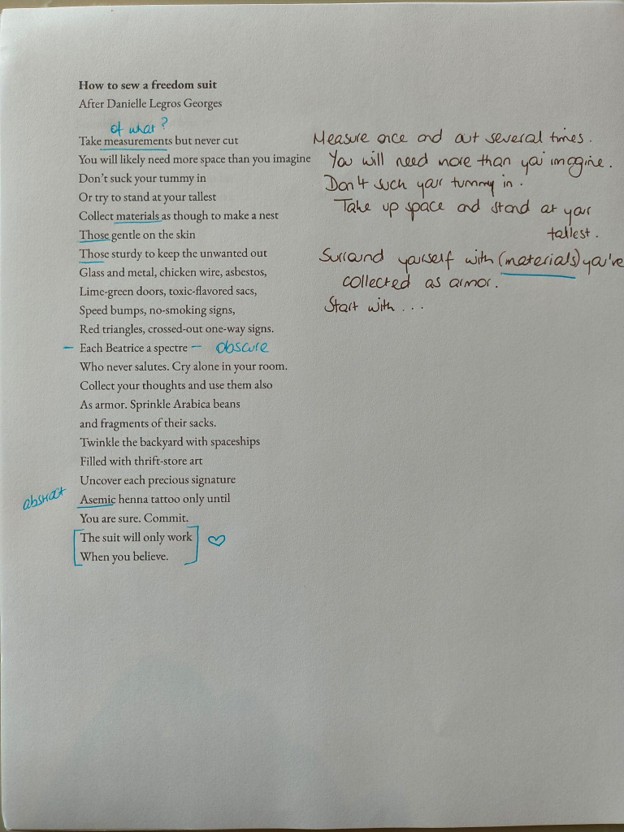

Asemic henna tattoo? Despite the fact that I loved the image, I felt that I’d gone too deep inside my head and provided in the poem a phrase that felt more like a distraction than anything useful. I wanted it to portray confusion, but not in this way. I wasn’t sure it fit this container.
.
Step 2
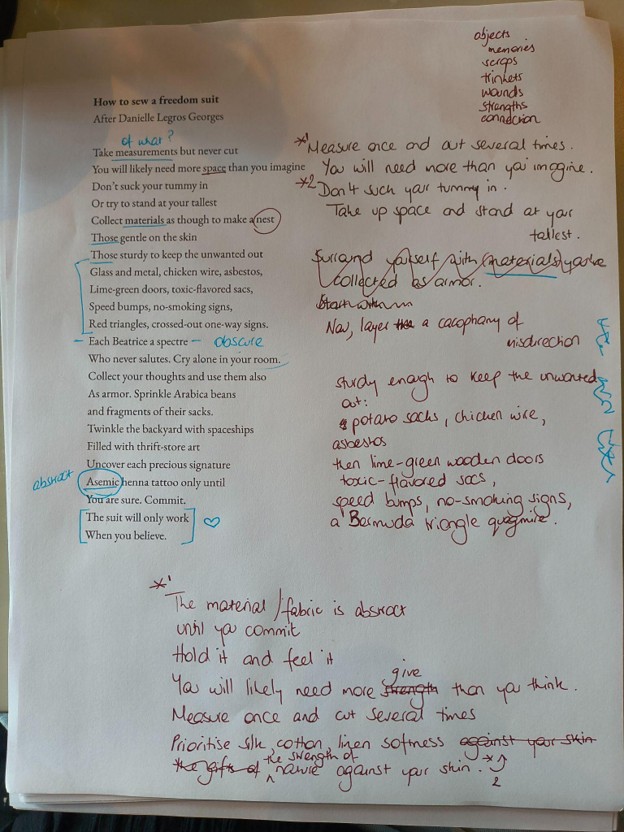
I continued to edit by rewriting or listing, in dark red, the lines I wanted to keep. I went back to the original idea to understand the message of my poem. I was sure that in my imaginary suit I’d want layers that felt soft against my skin. The word “nest” was key here. Although I wasn’t sure if I’d keep the word itself, I knew that whatever touched me—whether it was silky and tough or cotton and practical—had the role of comforting me while protecting me.
In this second step, I also focused on getting more specific with certain terms when it felt appropriate. I didn’t want to spoon-feed the reader, and yet I knew that if I had the choice to build a suit to protect my freedom, I wanted to get it right. Would they also choose toxic-flavored sacs? Probably not. But they would get the gist of the matter. Whatever you use to keep the unwanted out had to be vile, dangerous, mysterious, and kind of misleading. You didn’t want anyone clever figuring it out.
Step 3
Despite the huge edits, I wanted to maintain meaning. One element that stayed is the absurdity and magic realism quality of the first draft. I wanted to maintain these because the situation is actually absurd. That, especially as women, we have to defend our rights and our bodies so hard, requires a response to match. I changed one line to its opposite. Rather than “(Don’t) try to stand at your tallest,” I wrote, “Take up space and stand at your tallest.”
I asked myself who/what Beatrice and the allusions meant, and opted for a less obscure portrayal of what I wanted to say. I didn’t want the reader to feel quite like they’d landed in the quagmire of my thoughts.
Step 4

The poem now felt like it needed more breath and, therefore, space between ideas. It no longer suited the one-stanza format I’d started with, because the ideas felt like they were coming from different places to form a whole.
I seldom make such huge changes when I edit, but the steps in considering the work and challenging it tend to remain the same. At the moment, and probably for the longest time, my worst pitfall has been obscurity. I don’t think I can eliminate it, nor do I want to. It is part of my signature voice in poetry. I think that I made a good compromise here.
How to sew a freedom suit
After Danielle Legros Georges
The fabric is abstract
until you commit. Hold it and feel it.
Measure once and cut several times.
You will likely need more give than you think.
Prioritize silk, cotton, linen softness
the strength of nature against your skin.
Don’t suck your tummy in.
Take up space and stand at your tallest.
Now, layer a cacophony of misdirection
sturdy enough to keep those unwanted out:
potato sacks, chicken wire, asbestos.
Then flimsy lime-green doors,
toxic-flavored sacs, speed bumps,
no-smoking signs, a Bermuda triangle quagmire.
If your one true love walks by,
rest assured that they are just a specter,
an idea sent to distract,
who will never give you the light of day.
Don’t show them your face.
Cry alone in your room if you need to.
Collect your tears, a necklace to adorn your neck;
tears are armor, too. Fortify your home
with caffeinated motivation:
twinkle the backyard with spaceships
filled with thrift-store art.
Tattoo your promise on each fence
until you are sure.
The suit will only work
when you believe.


If you like this post, please share with your writerly friends and/or follow me on Facebook, Blue Sky, or Instagram. You can see all the FREE resources my site offers poets/writers on my Start Here page.