
Where my head’s at on reaching this landmark: six questions answered
In December, it’ll be 20 years since I first performed a poem on stage. Last week, I submitted my début (adult) collection for typesetting. This is where my head’s at.
There are six key questions I’ll address to try to capture this moment. As always, I’ll be as candid as possible, and as always, if there’s anything you’d like me to expand upon, leave a comment.
I appreciate that for some of you, writing and publishing a poetry collection might not be of interest. I completely understand that. But even so, I hope these questions will speak to ‘existing’ as a poet and offer insight into the mindframes we all attempt to navigate.
The six questions are: Why has it taken me this long to write an adult collection? Why this collection, and why now? What are my hopes and aims for this collection? How did it feel to submit the final manuscript? What have I learnt from the process? What do I see as the next steps, creatively?
Why has it taken me this long to write an adult collection?
There are multiple factors here. Firstly, I fell in love with poetry through listening to it. When I was 19, Pete Gardiner from Stiff Records gave me a Linton Kwesi Johnson CD, and it changed everything. At 17, I’d become obsessed with John Cooper Clarke and could recite most of his bootleg recordings word-perfect.
My love for poetry — and introduction to ‘the scene’ — came through watching live performances. This undoubtedly remains my favourite way to consume poetry, and I take an awful lot more from live performances than I do from the page or from pre-recorded content.

So, for me, I never automatically assumed that poetry primarily belonged on the page. I wrote exclusively with live audiences in mind. When I came into a windfall after doing the Nationwide ad, I never even considered a collection — my money went on taking a show to the Edinburgh Fringe in 2017, which then toured UK theatres in 2018. It was only when VERVE approached me to publish the show’s poems in a book that I even began to consider them on the page.
I also believe that class plays a role here. I come from a working-class background, and whilst creativity was always encouraged (my dad is a very talented painter), the publishing industry always seemed way out of reach, to the extent that it wasn’t even on my radar.
Finally, I have to confess that impatience is also a factor. Which makes sense considering I was diagnosed with ADHD in June last year, but when I first started, ADHD was just a lyric in a Natasha Bedingfield song.
If I’ve written a poem, I want it on MySpace Music within the hour, and I want to perform it at Escobar when I’m hosting an indie gig tomorrow night. No way am I spending two years chipping away at a manuscript with all of the poems in the dark.
Poetry is punk, it’s DIY, it’s urgent and essential. Spoken word poetry (or poetry spoken aloud) requires no barriers or equipment: it only needs an audience, an opportunity, a moment. This is what I loved about it in those early days and what I still love about it now. It can happen very quickly and spontaneously when it needs to, and if there are two things that a poetry collection isn’t, it’s quick and spontaneous.
Why this collection, and why now?
To be totally upfront, there are two reasons. The main being that I needed to tell this story, and a poetry collection felt like the only vehicle to do so. I realise that sounds painfully obvious. But this is my third major literary project to date (with the adult-focused material) — Two Little Ducks was only ever a stage show, and Bouncing Bricks quickly became a novel.
You have a story or a message burning inside you and have to trust your creative instinct for how that story should take form.
The story in question relates to my chaotic brush with the music industry in the late ‘00s. To cut a long story short, I began uploading poems to MySpace Music in late 2006; I was messaged by a songwriter/producer in May 2007; we signed to Universal Records in March 2008; and flew out to New York to record with the Dap-Kings in June 2008.
I was extremely young (19/20), overwhelmed, out of my depth, and before long, reliant on Bombay Sapphire to get through each day. Over the course of 2009, we went from being the ‘Next Big Thing’ in the broadsheets to the Radio 1 playlist, and then from a summer festival sensation to being a dropped act.
From August 2019 until August 2023, I was working on the novel, and as soon as that was sent off to the first prospective agent, the title poem for the collection burst out of me. I’d never written about that period of my life before, and I realised it was something I just had to do — for myself as much as anything else.
I firmly believe that as a writer or artist, you follow your gut when deciding on your next project. Because if there isn’t that burning desire inside you, you won’t see the distance. Not if you’re like me, anyway!
What are my hopes and aims for this collection?
Look, let’s be honest: we can deride ‘prize culture’ all we want, but we can’t deny that it pulls us in to an extent. It’s impossible to resist those fleeting moments when you fantasise about being shortlisted for the Forward or whatever.
Do I realistically believe that could happen with my collection? No. And don’t get me wrong: I’m extremely proud of my collection, and I do believe it has literary merit. I just don’t see that this particular square peg fits within their round holes, if you get me.
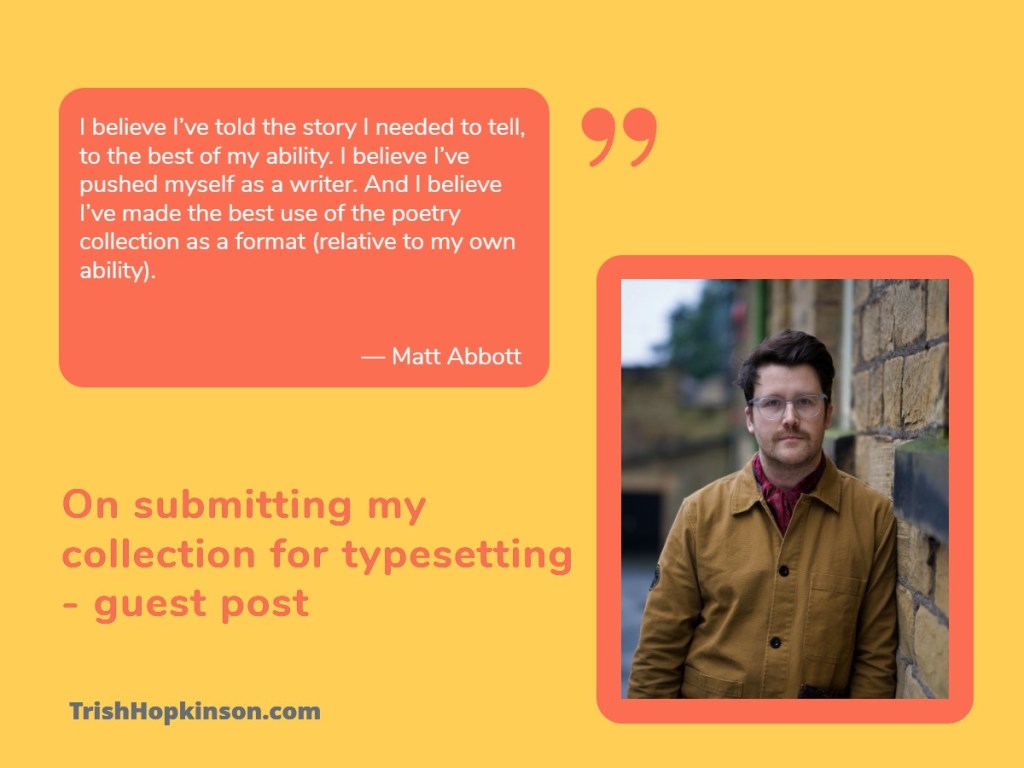
This might sound naff, but to be totally upfront, getting to this stage was my main aim. I believe I’ve told the story I needed to tell, to the best of my ability. I believe I’ve pushed myself as a writer. And I believe I’ve made the best use of the poetry collection as a format (relative to my own ability).
So, in that sense, anything else is a bonus. I can’t wait to gig it and to introduce it to audiences within a live setting. To share my story in a range of ways and hopefully shift a fair few copies along the way.
I’d love to connect with people, exchange memories, hear new stories and all that jazz. But really, having this as part of my (very modest) concrete literary output is huge for me.
All we’re doing as writers is building a life’s work. This is the piece that had to come next for me.
My collection is niche (albeit with universal themes) and many of the poems thrive within the collection’s specific context (a studio album, as you will), and I accept that. I don’t know if it’s too stagey for the literary crowd, too pagey for the non-literary crowd, or both. But this is how I wanted to tell the story — however people engage with it is up to them.
How did it feel to submit the final manuscript?
Honestly, it feels like a colossal relief. I’ve been working on the collection since August 2023 and had some brilliant mentoring sessions with Molly Naylor throughout 2024. When it was picked up for publication with Broken Sleep Books in August last year, I was over the moon, but since then, I’ve felt huge pressure to get the best out of it.
I did some more work on it earlier this year before being paired with an excellent editor to take it over the finish line. I’ll touch more on that in the next instalment of my monthly series on creating and publishing a collection.
Also, to be upfront, it’s given me a massive confidence boost. I feel immensely proud of it. I’ve put a lot of work into it and stretched myself as a writer. And having jumped over several hurdles (Molly giving me the green light to submit to Broken Sleep, Broken Sleep picking it up, and then my editor giving me the green light to submit it for typesetting), I know it’s a decent piece of work.
It’ll be a surreal experience to be ‘out there’ as a poet with a collection. I never did a book launch for Two Little Ducks because it wasn’t a collection: it was the poems from a stage show. So, I’m looking forward to that. But really, I’m just proud to have reached this stage, and I can’t wait to see what happens next.
One final aspect of this, which perhaps relates to question 1 as well. I’m diagnosed AuDHD. The autistic side of my brain finds written poetry extremely intimidating, and the ADHD side of my brain finds larger projects overwhelming. Wrestling with these two sides of my brain to reach this point is a huge achievement.
What have I learnt from the process?
I’ve learnt to frame certain stories or moments specifically for the page. Which may sound ridiculous twenty years down the line, but it’s true. This is my first (adult) project that’s put page-based poetry at the forefront.
To allow myself to be vulnerable with my own story, rather than hiding behind fictionalised kitchen-sink narratives, social observations, or political rants. To permit myself to tell stories even when the devil on my shoulder tells me nobody will be interested or able to relate.
And to open myself up to as many forms or styles of poetry as possible. A colossal thank you to Marjorie Lotfi for facilitating this through Marjorie’s Table: a few poems in this collection were inspired directly from those workshops, and they’ve helped me to access page poetry in a whole new way.
What do I see as the next steps, creatively?
Well, I have around a dozen poems on the go that belong in a separate collection. These poems were written alongside the latter stages of Peacocks Can’t Swim, but didn’t belong thematically or stylistically. So, the second collection will continue to percolate in the background.
My début novel follows in April, so most of my creative energy will be focused on finalising that manuscript between now and the New Year. To be upfront, I feel like a second novel might be my next major project. I also want to try adapting Bouncing Bricks for the screen.
But really, I think it’s important to spend a while embracing this moment. Enjoy reaching the milestone without the pressure to dive straight into something else. The longer I’m in this game, the more I realise that the moments in between, where you allow yourself to live, are as important as any intense writing periods.
Matt Abbott is a poet and novelist from Wakefield. His spoken word show, Two Little Ducks, explored working-class support for Brexit, intertwined with his experiences volunteering at the Calais Jungle. The show’s poems were published by VERVE in 2018. His debut adult collection, Peacocks Can’t Swim (Broken Sleep, 2027), revisits his chaotic period as a signed musician in the late ’00s. His debut novel, Bouncing Bricks (The Book Social, 2027), explores how white working-class men are radicalised by the far-right.
The Day Job is Matt Abbott’s behind-the-scenes space for exploring the realities of being a working poet — the graft, the gigs, the creative process, the industry, and the stories that never make it into the books. It’s where he shares candid reflections, monthly insights, and the ongoing journey of building a life’s work as an artist. Enter your email to subscribe below.


If you like this post, please share with your writerly friends and/or follow me on Facebook, Blue Sky, or Instagram. You can see all the FREE resources my site offers poets/writers on my Start Here page.