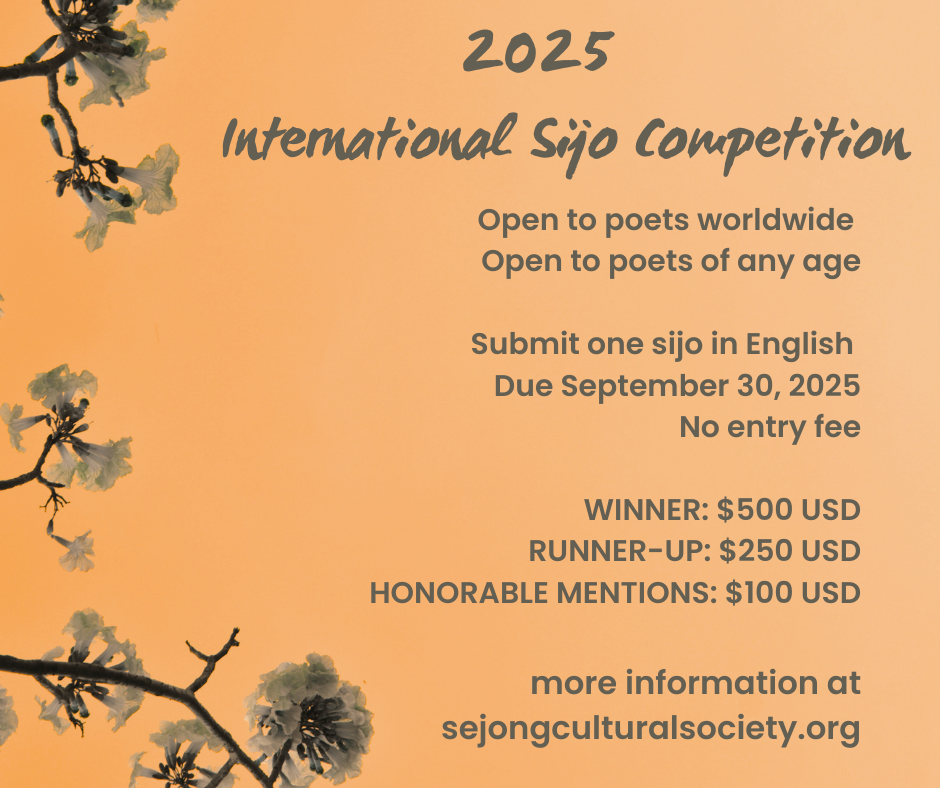
 The Sejong Cultural Society is a 501(c)(3) not-for-profit organization founded in Chicago, IL in 2004. They are currently open for no fee entries for their Sejong International Sijo Competition. The sijo is a traditional three-line Korean poetic form organized technically and thematically by line and syllable count. Click here for a basic guide on writing sijo.
The contest is open to all ages and awards cash prizes ranging from $100 – $500. For more information, see my interview with Executive Director Lucy Park and a link to contest guidelines below.
HOPKINSON: Tell me a little bit about The Sejong Cultural Society.
PARK: Based in Chicago, IL, the Sejong Cultural Society is a 501(c)(3) not-for-profit organization since 2004. Our mission is to advance awareness and understanding of Korea’s cultural heritage amongst people in the United States by reaching out to the younger generations through contemporary creative and fine arts. It is our hope that, through this, the rich culture behind Korea’s colorful history will be accessible to people of any ethnicity and nationality while being a unique part of the larger, more familiar Western culture, and that such harmonizing of the two cultures will create a better understanding between them.
HOPKINSON: How/why was Sijo Competition originally started?
PARK: We started the Sejong Music Competition in 2004 and Sejong Writing Competition in 2006, which initially included only an essay competition.
Two years after beginning our writing competition, our planning committee chair, Professor Heinz Insu Fenkl (SUNY New Palz), asked us if we were interested in adding a sijo competition and introduced us to his friend Professor David McCann at Harvard University. We were surprised at the thought of writing sijo in English. To us, sijo was an esoteric form of poetry, an old cultural remnant only a handful of poets—not lay people—dabbled in; our exposure to sijo was limited to those great poems written by highly respected traditional scholars. It had never occurred to us to attempt writing them ourselves. But after speaking with Professor McCann, who was already teaching sijo to his students at Harvard University, and investigating on the internet, we discovered that sijo had already been enthusiastically embraced by a small community of American and Canadian poets.
Soon I learned from others that American students were taught various forms of poetry as early as grade school, and that one of the most ubiquitous forms was the Japanese haiku. If one form of Asian poetry could manage such widespread dissemination among Americans, we wondered, why couldn’t another?
After further discussion with and encouragement from Professors McCann and Fenkl, in 2008 we launched the sijo category of our writing competition in collaboration with the Korea Institute at Harvard University. As we launched the sijo competition, we posted materials on how to write and teach sijo on our website. Then we embarked on an expansion of educational programs for American educators on how to teach sijo in their classrooms. Our competition asked students to write a single sijo in English on any subject, and it quickly became a success: our second year saw nearly triple our first year’s entries, and the numbers continued to increase from there, up to thirteen hundred sijo from forty-one states in 2014. In response to overwhelming demand, we expanded the age category to adult (19 years and older) in addition to the pre-college division (18 years and younger) in 2019. Here is the website with winners and their sijo.
Then we started the Sejong International Sijo Competition in 2021. Poets of all ages from 19 countries responded to our call. You may read the winners and their sijo here.
HOPKINSON: Who is your target reader audience?
PARK: The Sejong International Sijo Competition is open to poets of all nationalities and all ages.
HOPKINSON: What type of work are you looking for?
PARK: Poems written in English in a sijo format; a total of 45 syllables written in 3 or 6 lines.
HOPKINSON: What do you wish you’d see submitted, but rarely comes in?
PARK: No such things.
HOPKINSON: What are some of your favorite lit mags/journals?
PARK: Poetry magazine from the Poetry Foundation in Chicago.
HOPKINSON: What is your favorite part of being on staff with the Sijo Competition?
PARK: Meeting people from all corners of life who enjoy learning about a new form of poetry, sijo. And discovering new talents. Some wrote wonderful sijo who have never liked writing other types of poems.
HOPKINSON: Where can we send submissions?
PARK: Submit sijo via this online form
HOPKINSON: If someone has a question, how can they contact you?
PARK: Send an email to SejongCulturalSociety@gmail.com
Click here to read submission guidelines.
SUBMISSION DEADLINE: Sept. 30, 2025 (12 midnight, Central Time)
THEME(S): any topic
FORMAT: Sijo, learn how to write sijo by visiting our website and watching lectures on the Sejong Cultural Society YouTube channel.
- Basics of sijo: https://www.sejongculturalsociety.org/writing/current/resources/sijo_guide.php
- Various resource on learning and teaching sijo: https://www.sejongculturalsociety.org/resources/resources.php
- Watch lectures on sijo writing and teaching at the Sejong Cultural Society YouTube channel: https://www.youtube.com/user/KoreanTheme
SUBMISSION FEE: None
PAYMENT: Winners will receive a cash prize.
- Winner: $500 USD
- Runner-up: $250 USD
- Honorable Mentions: $100 USD
ISSUE FREQUENCY: The Sejong International Sijo Competition is an annual event.
AVERAGE RESPONSE TIME: We announce winners about a month after the submission deadline.
SUBMISSION METHOD: Online form
SIMULTANEOUS SUBMISSIONS: Only one sijo per person
FORMS: sijo (Korea’s poetry form), essay
SOCIAL MEDIA: X (Twitter), Facebook, YouTube
If you like this post, please share with your writerly friends and/or follow me on Facebook, Blue Sky, or Instagram. You can see all the FREE resources my site offers poets/writers on my Start Here page.
Discover more from Trish Hopkinson
Subscribe to get the latest posts sent to your email.