A former pastor of mine argued that the Biblical first act of human speech was poetry: Adam calling Eve “bone of my bone/flesh of my flesh.” This experience of woman’s creation was so spectacular to Adam that couldn’t respond with a simple narrative. There was something supernatural, seemingly inexpressible about his experience that made poetry the only adequate response.
Likewise for us as poets, we turn to the form of poetry when other forms have failed us. A poem should be a natural outpour from an inward experience. There is something about the form of poetry that invites complexity, and the inexpressible. But that means then that we have to have some idea or sensation that first compels us to write a poem.
Maybe because of my background in prose, I find myself most inspired to create poems when I have a gripping physical moment: this is often a memory, but can also be an object, a place, an image, a person I meet, or a sensation. It can’t be just any memory or place though—there has to be some sort of dissonance, something that seems inexpressible or that needs to be explored.
 For example, I find myself mentally going to ruins for inspiration: their original state can’t be resurrected. They’re uninhabited, and in disrepair. So there’s something inadequate about the sight of an abandoned house. I want something as a poet: I want to describe the sensation in a ruined object, I want to resurrect a living place that no longer exists and reach some ineffable feeling inside me that reacts when I see a ruin. So in short, I find that ruins inspire poems because they are something I need to in some way, shape or form explore.
A powerful tool that poets use to try to reach the unreachable is imagery. When I try to understand a ruin, I first describe what I see. I hone into the physical, visual objects to try to make meaning of what I’m experiencing, and what happened in this place.
If you look at Anne Carsen’s “Father’s Old Blue Cardigan”, you’ll see that the physical, visual object of the cardigan is what launches Anne into writing a poem. She doesn’t merely describe what the cardigan looks like but uses that object to delve into her father’s health, and her relationship with her father. The cardigan is a vehicle for Carsen to explore a relationship that can’t be explicitly explained.
Another example is Carolyn Forche’s “The Colonel.” If you ask me what I remember about this poem, it’s the image of the ears being poured on the table, “like dried peach halves.” That image does so much work—it is so much more powerful than an explanation from the colonel, or an abstract monologue from the speaker.
Ezra Pound is quoted for saying “the natural object is always the adequate symbol”. That is to say, an image can do more work for us than “poetic” language. Through the use of an image that exists in a shared reality, we can more effectively express abstractions and complicated ideas. That isn’t to say that we are limited to writing about the concrete world, or that we can’t be inspired by abstractions or sounds. But in whatever world we’re writing in, the writing is most powerful when it creates an image, something the reader can see and relate to. Perhaps why I have narrative tendencies, and find inspiration from my own experience, is that the images are much easier to take hold of. I can remember what I’ve seen if I’m writing from a memory.
Wherever your poem travels, see if you can end it on an image. Give us something at the end that shows more than it tells, that will haunt us even after we finish reading the poem.
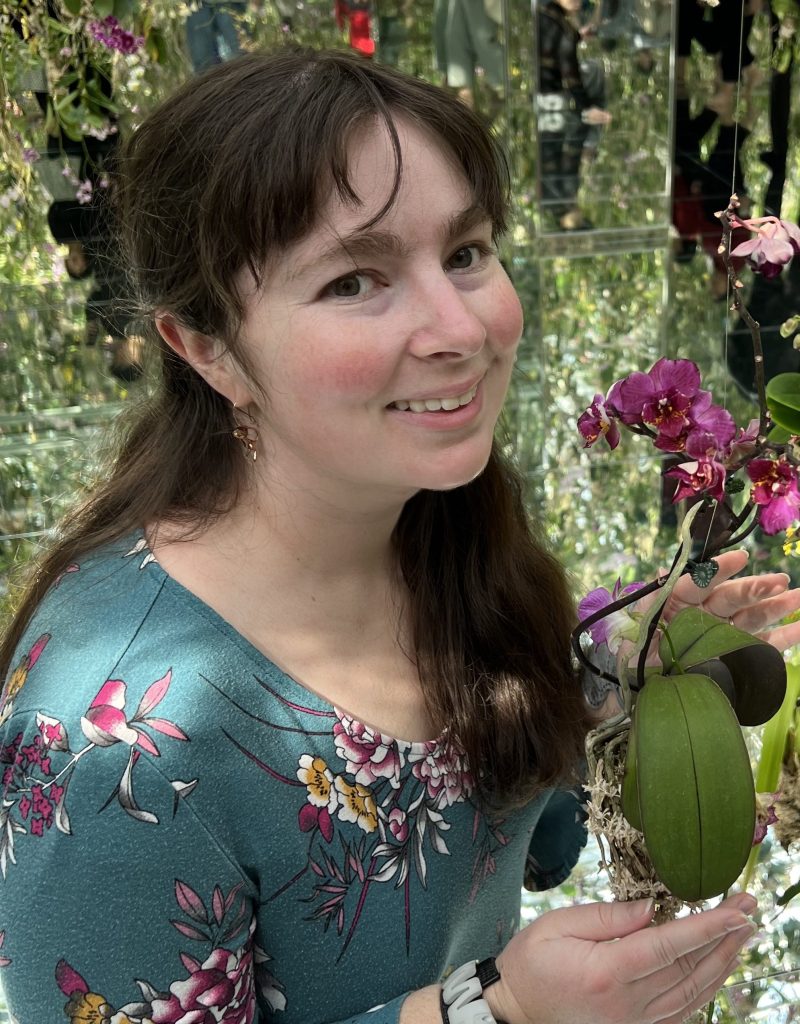 Meg Eden Kuyatt is the author of the 2021 Towson Prize for Literature winning poetry collection “Drowning in the Floating World” and the forthcoming “obsolete hill” (Fernwood Press, 2026) and children’s novels including the Schneider Family Book Award Honor-winning “Good Different,” “The Girl in the Walls” and “Perfect Enough,” all with Scholastic. When she isn’t writing, she teaches creative writing students. Find her online at megedenbooks.com.
.
If you like this post, please share with your writerly friends and/or follow me on Facebook, Blue Sky, or Instagram. You can see all the FREE resources my site offers poets/writers on my Start Here page.
Discover more from Trish Hopkinson
Subscribe to get the latest posts sent to your email.
Categories: Guest Blog Posts, Self-taught MFA