“Literature is impoverished beyond our counting by the doors that have been shut upon women.” —Virginia Woolf
In the famous, book-length essay “A Room of One’s Own” (1929), Virginia Woolf comments on the disempowerment faced by women throughout history. The lack of opportunity and resources, she claims, have kept women in the margins. “I would venture to guess that Anon, who wrote so many poems without signing them, was often a woman,” Woolf writes. Embraced by the 1970s movement of feminist literary criticism, Woolf’s work gained new acclaim, launching her into the public eye. As a result, her iconic quote underwent a transformation and was rephrased to encompass all women who’ve been overlooked and erased from the chronicles of time: “For most of history, Anonymous was a woman.”
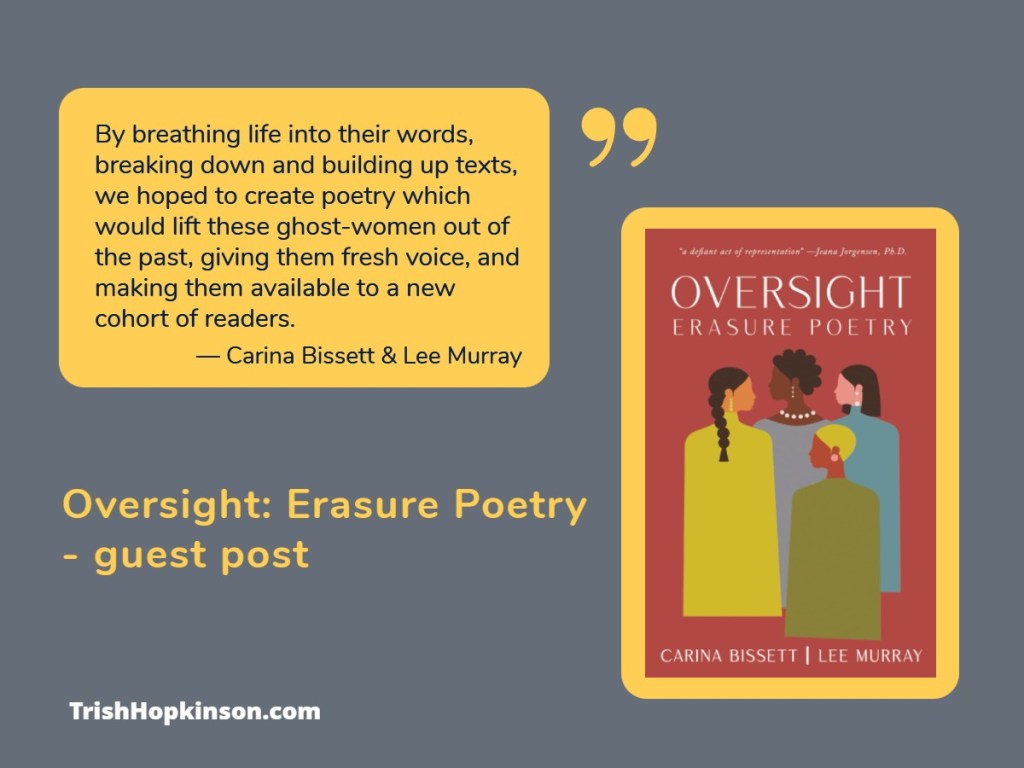
When we first started talking about the project that would become Oversight: Erasure Poetry, we knew we wanted to lift and craft poetic narratives from writings by women from history. By breathing life into their words, breaking down and building up texts, we hoped to create poetry which would lift these ghost-women out of the past, giving them fresh voice, and making them available to a new cohort of readers.
the phantom / othered and tormented / you may not have heard of her
We agreed that erasure poetry was the perfect form for the task at hand. There are several different ways to approach erasure or blackout poetry, which is a subcategory of found poems. In some cases, poets work with a single page from a text, blacking or crossing out words, leaving the select remaining few to surface like ghost fish in a dark pond. In other cases, a poet might cut words out of a larger text, before reassembling them in a new form or shape. Another option is to retype the selected words or phrases, leaving space where the original text was in order to create a conventional poetic presentation.
 Even though some of the texts we were considering for Oversight were only a page or two, many more were entire essays or complete books. With this in mind, we created a different set of constraints for the project. Regardless of the form of the text—poetry, patents, essays, speeches, transcripts, travel journals, letters, autobiographies, and so forth—we decided that the words we selected must be presented in the same order as they appeared in the original text. We also agreed that our found poems, must represent the original text and the intention of the women we were revealing in these new pieces of erasure.
The project resounded with promise, with possibilities. With joy. Not only that, but it was also the perfect vehicle for a collaboration between us, a way to connect our individual work over recent years, combining poetry, feminism, and experimental literary approaches. More than that, as we shared texts by women we felt worthy of closer study, women whose voices had been belittled and sidelined, the project became a conversation, a dialogue to the past from the present, crossing oceans and time, as we connected not only with one another, but also with the incredible women whose words we collected and curated.
“Sor Juana Inés de la Cruz was a seventeenth-century, colonial Mexican nun who set precedents for feminism,” Carina wrote on one occasion, declaring her “a woman before her time.” Carina captured her passion in an erasure poem from Cruz’s “You Foolish Men,” in which the author castigates the men of New Spain for applying a double standard against women in sexual relationships. Here is an extract:
You foolish men
invite, incite, fight—
guile a show you act.
You foolish men
complain she’s loose,
censure unfair, cruel.
“I don’t know if this speech is available,” Carina said of Toshiko Kishida’s ‘Daughters in a Box’ speech, “but it sounds really cool.” Toshiko’s feminist discourse is notable as she chastised reformist Japanese society for clipping and containing the development of its daughters by limiting their movements and restricting their education. Kishida was arrested and charged for this speech, and spent time in jail, as Japanese authorities judged its content as political rather than academic, and, in accordance with then-law, the address required a permit. The daughter of a much-absent merchant father and hardworking mother, Kishida was brave enough to resign from a secure position as a monji goy? gakari (tutor) in the Empress Haruko’s court—the first commoner to achieve this status—in order to agitate for women’s equality. The speech resonated for Lee, who is of Asian heritage herself, and the following is an excerpt from the resultant erasure poem she lifted from Rebecca L. Copeland and Aiko Okamoto’s translation of the speech, sourced in The Modern Murasaki: Writing by Women of Meiji Japan:
daughters in boxes
girl-creatures
no hands and feet, unable to speak
formless sisters
daughters in boxes
I eat one
pant and retch wide
filled with good daughter
she should raise herself
a bright force, a construct of rage
“Women’s history is an assertion that women have a history.”—Toshiko Kishida
In her July 2022 essay “On Erasure” for the Poetry Foundation, Leigh Sugar claims the “erasure poem may be defined by inclusion and/or exclusion—both actions will produce an effect. So, rather than define erasure poetry as a form that solely reveals what may be hidden, we might well understand it as a form and action that, when engaged consciously, can illuminate, for the purpose of celebrating, condemning, revealing, or interrogating, that which is otherwise invisibled.…”
 We agree with Sugar’s definition since the poems included in Oversight: Erasure Poetry are, in effect, translations of the original texts. In some cases, they are translations of translations. And with each translation—whether it is the English adaptation of Veronica Franco’s Venetian capitolos or Marie-Sophie Germain’s theory of elasticity published in a French academic journal—the collaborator is effectively creating a variant of the original. Each new translation, each new variant, offers new insight, our purpose, as Sugar says, to illuminate, celebrate, condemn, reveal, or interrogate, that which is otherwise invisible, to lift women’s stories from obscurity.
“Most intellectual development depends upon new readings of old texts. I am all for putting new wine in old bottles, especially if the pressure of the new wine makes the bottles explode.”—Angela Carter
Oversight: Erasure Poetry is available for preorder from Running Wild Press. The book will be released on International Women’s Day (8 March 2026).
.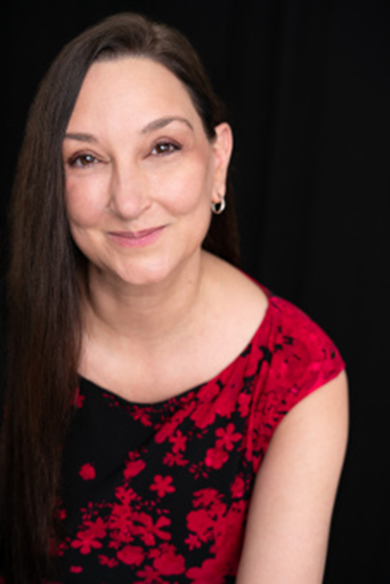 Carina Bissett is a writer, poet, and editor working primarily in the fields of dark fiction and fabulism. She has written numerous short stories, many of which are featured in her debut collection Dead Girl, Driving and Other Devastations (2024), and she is also a co-editor of the award-winning anthology Shadow Atlas: Dark Landscapes of the Americas (2021). Her poetry has been nominated for the Rhysling Award, the Pushcart Prize, and Sundress Publications Best of the Net. Her nonfiction has been nominated for a Bram Stoker Award®. Links to her work can be found at http://carinabissett.com.
 Lee Murray ONZM is a writer, editor, poet and screenwriter from Aotearoa New Zealand, a Shirley Jackson Award and five-time Bram Stoker Award® winner. A USA Today bestselling author with more than forty titles to her credit, Lee holds a New Zealand Prime Minister’s Award for Literary Achievement in Fiction and is an Honorary Literary Fellow of the New Zealand Society of Authors. Among her works are feature film Grafted (Propaganda-Fluroblack) directed by Sasha Rainbow, horror anthology This Way Lies Madness (Flame Tree Press) co-edited with Dave Jeffery, and Oversight: Erasure Poetry (RIZE) a collaboration with Carina Bissett. www.leemurray.info
*This article includes excerpts from Oversight: Erasure Poetry by Carina Bissett and Lee Murray, releasing 8 March 2026 from Running Wild Press.
Found haiku (in italics) sourced from Virginia Woolf, “Professions for Women” (1931), a speech given to the London branch of the National Society for Women’s Service, UK. Retrieved from: https://www.literaturecambridge.co.uk/news/professions-women.
If you like this post, please share with your writerly friends and/or follow me on Facebook, Blue Sky, or Instagram. You can see all the FREE resources my site offers poets/writers on my Start Here page.
Discover more from Trish Hopkinson
Subscribe to get the latest posts sent to your email.
Categories: Found Poetry, Guest Blog Posts, Self-taught MFA




1 reply »