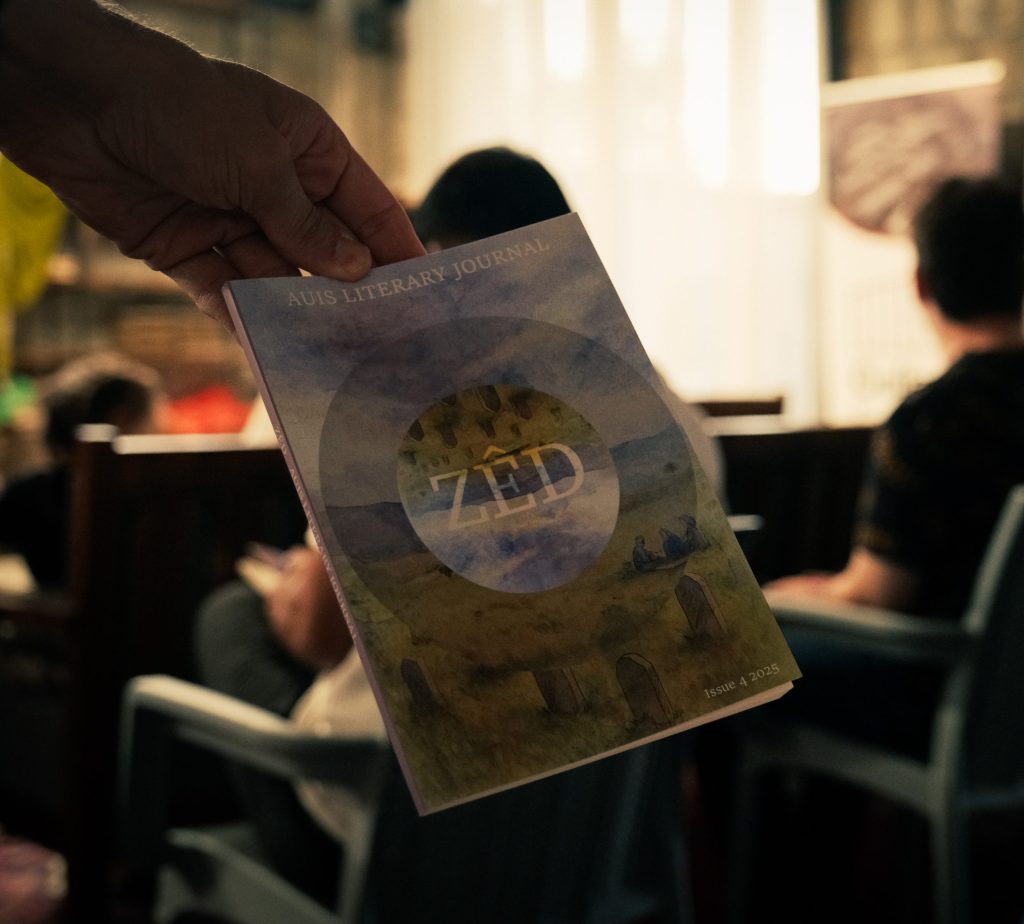
 For poets and writers in the Kurdistan Region, Iraq, and beyond, AUIS Literary Journal has become a vibrant annual gathering place for multilingual, cross?genre creative work. I was delighted to have two poems—“Academia Galleria” and “Pandemic Plums”—included in their most recent print issue, and I’ve been consistently impressed by the care and collaborative energy behind the journal. They’re currently open for submissions until April 15, making this the perfect moment to learn more about their mission, their editorial vision, and the growing literary community they’re nurturing at the American University of Iraq, Sulaimani. In this interview, editor Sanaria Jalal offers a closer look at what makes the journal such a meaningful space for emerging and established writers alike.
HOPKINSON: Tell me a little bit about AUIS Literary Journal.
JALAL: AUIS Literary Journal is an independent university journal run by student and faculty volunteers at the American University of Iraq, Sulaimani. Its aim is to celebrate literature and creativity by local writers in the Kurdistan Region and Iraq, as well as international writers. It is published once a year, usually in May.
HOPKINSON: How and why was AUIS Literary Journal originally started?
JALAL: The idea for the journal emerged in spring 2018 with the mission of encouraging and showcasing diverse literary and artistic voices connected to the AUIS community. We publish original poetry, fiction, creative nonfiction, artwork, and photography in an annual print journal. Our goal is to highlight the diverse struggles, traditions, and cultures in Iraq and the surrounding regions, and to situate Iraqi writers and their themes within a broader global aesthetic.
HOPKINSON: Who is your target reader audience?
JALAL: Our main audience is young literature lovers in the Kurdistan Region and Iraq. We hope to revive the tradition of reading print literary journals among youth while also engaging anyone interested in creative writing, regardless of age or background. At the same time, the journal reaches our many contributors around the world.
HOPKINSON: What type of work are you looking for in submissions?
JALAL: We are a multilingual, cross?genre publication accepting creative work in Kurdish, Arabic, and English. For this year’s issue (Issue No. 5), we accept poetry, fiction, and creative nonfiction. We also welcome work that pushes beyond traditional literary boundaries—visual poetry, documentary poetry, collage poetry, and other hybrid forms. Our interest in the experimental is meant to be inclusive, not exclusive.
HOPKINSON: What do you wish you’d see submitted more often?
JALAL: We receive a wide range of excellent work each year. In addition to hybrid and mixed?medium pieces, we’d love to see more linguistically playful submissions—writing that intentionally experiments with words, syntax, sound, and rhythm to create sensory experiences for the reader. We want work that delights on the page and invites readers to physically feel the experiences conveyed.
HOPKINSON: What are some of your favorite lit mags or journals?
JALAL: Two of my favorites are Brevity and Wildness. Their inventive and concise approach to creative work resonates with me. In a world where our attention is constantly pulled in many directions, it’s not always possible to sit down with a long read. These journals offer succinct, striking pieces—just enough to keep the creative nerve alive.
HOPKINSON: What is your favorite part of being on staff with the AUIS Literary Journal?
JALAL: Most of our staff are undergraduate students, so the journal is their first encounter with editorial work. We face challenges together, grow together, and make memories together. After months of hard work—often in the evenings and on weekends—it’s incredibly rewarding to finally hold the printed copies in our hands. Seeing what we’ve created, especially as undergraduates, is joyful and gratifying. Many members stay involved even after graduation.
HOPKINSON: Where can writers send submissions?
JALAL: You can submit directly through our Google Form.
HOPKINSON: If someone has a question, how can they contact you?
JALAL: We’re always happy to answer questions at: auislitjournal@auis.edu.krd
HOPKINSON: Is there anything exciting coming up you’d like to mention?
JALAL: We’re planning to take the journal online to reach a wider audience, and our website is currently in development. We will continue printing physical copies to preserve the tactile and olfactory pleasures of reading in print.
Click here to read submission guidelines.
- SUBMISSION DEADLINE: April 15, 2026
- FORMAT: Print; soon to be available online
- SUBMISSION FEE: None
- PAYMENT: Contributor copy
- ISSUE FREQUENCY: Once a year, usually in May (contributors may receive copies over the summer due to international shipping)
- AVERAGE RESPONSE TIME: Four weeks
- SUBMISSION METHOD: Google Form
- SIMULTANEOUS SUBMISSIONS: Yes
- FORMS: poetry, fiction, and creative nonfiction, including visual poetry, documentary poetry, collage poetry, and other hybrid forms
- SOCIAL MEDIA: Facebook, Instagram, LinkedIn
If you like this post, please share with your writerly friends and/or follow me on Facebook, Blue Sky, or Instagram. You can see all the FREE resources my site offers poets/writers on my Start Here page.
Discover more from Trish Hopkinson
Subscribe to get the latest posts sent to your email.