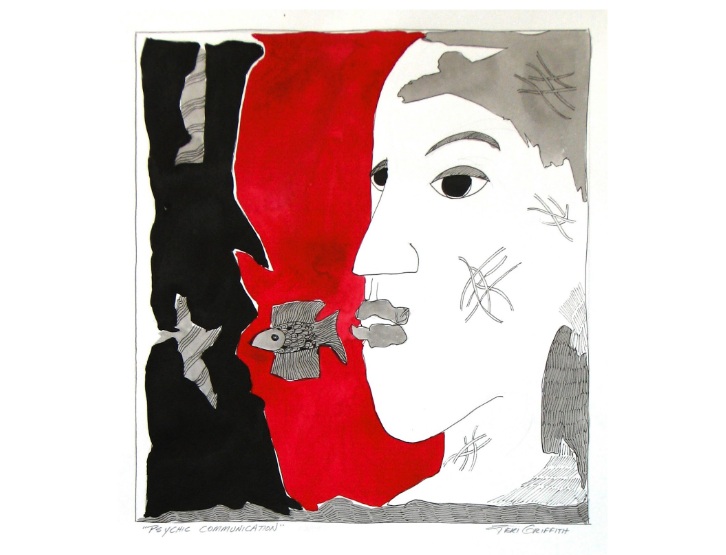
Jeri Griffith’s “Psychic Communication” appears in Issue 16 of Glint Literary Journal.
I recently spoke with Brenda Mann Hammack, Managing Editor and Publisher of Glint, a journal that loves variety—lyric, strange, playful, hybrid, and everything in between. What started as a student capstone project at Fayetteville State University has grown into a volunteer-run space that champions bold voices and inventive forms.
Brenda shared how the journal has evolved, what she’s looking for in submissions, and why she’s excited about cross-genre and cross-media work. Glint is fee-free, publishes once a year, and welcomes fiction, poetry, creative nonfiction, visual art, and more. If you’re experimenting or blending forms, this is a great home for that kind of work.
Full interview and submission details below.
HOPKINSON: Tell me a little bit about Glint.
HAMMACK: Glint is a literary miscellany for a digital age. Its genres and themes are as varied as its moods. Some contributions would suit a lyrical field guide. Some appear to have been lifted from an edgy contemporary commonplace book. Some contributors confess. Some prevaricate. Some challenge while others play. Glint wants to be a platform for compelling voices and innovative works.
HOPKINSON: How/why was Glint originally started?
HAMMACK: The journal began as the culminating project of a capstone course at Fayetteville State University, an HBCU, in 2010. After the professor who taught the course left the university, I was asked to serve as advisor to the students who wanted to keep it operating. There were only three students involved in the second issue, and the submission load quickly overwhelmed us all. For issue 3, I was able to recruit faculty to join students on the editorial board.
We’re still affiliated with the Department of English at FSU today, where I serve as coordinator of the concentration in creative and professional writing, but I’ve taken on the roles of publisher, managing editor, and web designer. I assumed the costs of maintaining the website with issue 6. The editorial consists of volunteers (present and former faculty, alumni, and occasionally interns). Some former contributors and independent writer friends also contribute when time allows. Sonya C. Brown continues to assist, especially with book reviews and prose submissions.
HOPKINSON: Who is your target reader audience?
HAMMACK: Readers of literary journals are often potential contributors. If you scan the contributors’ bios for any issue of Glint, you will see that we publish work by authors who have published widely. We’ve also been delighted to introduce emerging writers, including some exceptionally talented high-school students.
We do attract readers with highly literary tastes, but I also like to share samples with students in my poetry, creative nonfiction, and composition classes. Some non-English majors already love poetry, but those who don’t often change their minds when exposed to relatable voices and perspectives. Currently, I’m finding those who plan to apply to creative writing programs are especially inspired by exposure to hybrid-genre contributions.
HOPKINSON: What type of work are you looking for in submissions?
HAMMACK: As an editor, I’m looking to avoid homogeneity.
While I do lean toward short-form submissions in prose, I do accept longer pieces if the voice, style, and/or perspective offers something I can’t find in other submissions in any given issue.
Flash prose stands a stronger chance, overall, because practitioners of those forms are often attentive at the word level. I also appreciate prose submissions that engage in speculative, surreal, and quirky business.
With non-prose submissions, I like formal verse (sonnets, villanelles, sestinas) as much as I like persona and prose poems. We often place the latter in the hybrid section unless a contributor prefers the poetry section. The same goes for found, erasure and blackout pieces; modular, braided, mosaic, fragmented, ekphrastic, concrete, and micro forms.
I teach creative nonfiction so I’m always delighted to receive : lyric, visual, fragmented, or braided essays; object or concept odes in prose form; verse memoir; experimental and ekphrastic approaches to other art forms.
Book review submissions are more likely to be considered if submitted in summer or closer to the December publication date when I’m not teaching an overload while chairing multiple committees.
Visual submissions can be submitted throughout the year. We usually feature multiple pieces by at least one artist in every issue. Would-be contributors often share links to online portfolios in their cover letters. If accepted writers are also visual artists, I’m likely to contact them to see if they are interested in submitting images as well.
HOPKINSON: What do you wish you’d see submitted, but rarely comes in?
HAMMACK: We’re particularly interested in receiving work from individuals who create in multiple genres and/or art forms. We would also like to see more collaborative submissions. Though I’m primarily interested in collaborations between human creators, I’m open to experimentation with bots so long as digital collaborations are acknowledged and justified.
I teach digital storytelling and I’m preparing to teach a capstone class on creativity next fall so I’m open to receiving submissions that explore cross-media innovations. We’ve published photo essays as well as text-and-image lyric sequences in the past, but I’ve only received a few pieces with sonic features.
HOPKINSON: What are some of your favorite lit mags/journals?
HAMMACK: I really loved (and miss): A capella Zoo, Anthropoid, and Menacing Hedge. I still love Mudlark, BlazeVox, Brevity, Tin House, Orion Magazine, Eclectica Magazine, 3Elements Review, and SORTES.
HOPKINSON: What is your favorite part of being on staff with the Glint?
HAMMACK:
- Making connections with and being inspired by other creators in various genres/media
- Also, sending acceptance letters and publication notices
HOPKINSON: Where can we send submissions?
HAMMACK: glintsubmissions@gmail.com
HOPKINSON: If someone has a question, how can they contact you?
HAMMACK: For Glint-related correspondence, the submission address, though I check it more regularly when the university is not in session.
Click here to read submission guidelines.
- SUBMISSION DEADLINES: April 30, 2026
- FORMAT: Online
- SUBMISSION FEE: None
- PAYMENT: None. Since we don’t receive any funding, we aren’t able to offer payment to contributors.
- ISSUE FREQUENCY: We publish annually in late December.
- AVERAGE RESPONSE TIME: The response time depends on the date of submission. We usually receive the bulk of submissions in the spring and make most decisions in late May or early June.
- SUBMISSION METHOD: Email
- SIMULTANEOUS SUBMISSIONS: Yes
- FORMS: Fiction, poetry, creative nonfiction, visual art, book reviews
- LISTINGS: Duotrope
- SOCIAL MEDIA: Facebook
If you like this post, please share with your writerly friends and/or follow me on Facebook, Blue Sky, or Instagram. You can see all the FREE resources my site offers poets/writers on my Start Here page.
Discover more from Trish Hopkinson
Subscribe to get the latest posts sent to your email.
Categories: Call for Submissions, Fast Response, Interviews, Online Lit Mag/Journal