Recently an interviewer asked me about how I use the element of surprise in my poems. You can check it out, scan down, and read her whole question and my answer if you’d like to, but right now I want to tell you what I didn’t say.
The specific poem she was curious about was one of ten I’d generated from an exercise I’d given myself because it seemed like something interesting to try: “Make the title a conditional intro phrase, then make the first line the subject-verb follow-through.”
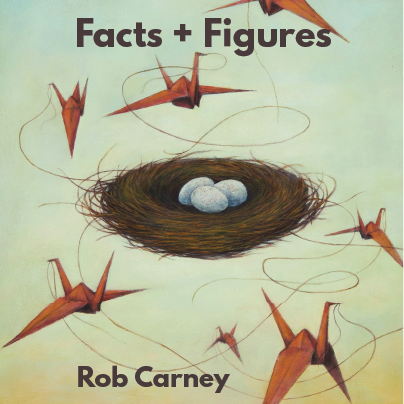
 You can find the results in my new book Facts and Figures (Hoot ’n’ Waddle 2020), but for now you just need the titles as a demonstration in case you’d like to try this yourself: “If I Were Writing the Horoscopes,” “Because Summer Has Fourteen Kinds of Orange,” “When I Went to Work as a Snow-Globe Designer,” “Since Some Crows Used to Be Angels,” “After They Put Up the Duck Xing Sign,” “If You Want to Make the Alphabet,” “Because All Orcas Have a Way with Words,” “When a Black Cat Crosses Your Path,” “Since They Ran Out of Money in Pleasant Grove,” and “After They Resurrect the Mastodon.”
Those titles (and original ones you can come up with) didn’t just spark my curiosity, they forced me to finish the thought and set the hook. I don’t mean hooking the reader—though hopefully that happens too—I mean I hooked myself. I mean I wanted to see what came next, and then next, until the end.
Here’s an example. I’m picking this one because the title and immediate next thought made me smile. To me, that’s always a good sign I’m onto something:
WHEN I WENT TO WORK AS A SNOW-GLOBE DESIGNER,
I didn’t do it for the usual reasons.
I did it to get some practice in
before building my house at the bottom of the ocean.
Less traffic noise, for one thing,
and I’ve traded crows for manta rays . . .
a million fish like clouds
of colorful rain.
And my yard is a coral reef,
and I never shovel the sidewalk
since the snow just floats suspended in my dome.
You ought to come visit me. We could open some wine
and watch the sharks cruise over . . .
then sit together by the fireplace,
impossibly warm.
The bonus, after the opening sentence, was that I’d created a need for the lines that follow. What are the usual reasons? Probably money (boring), so I skipped ahead to my unusual reason. And after that, the rest was just logical progression, imagery, and a turn before the final closure. By “turn” I mean a redirect—saying something different, or reaching out to the reader; anything so long as it feels like you’ve moved away from the main idea/mood/scene into Act 3.
Speaking of closure, here are two more bonuses if you’ll give this exercise a try:
First, you can’t possibly have a predetermined ending in mind, and why write if you already know what the end is? That’s not fun, that’s just another chore to do. And second, this method will hit you with surprises while you’re writing, so your poem will surprise the reader too.
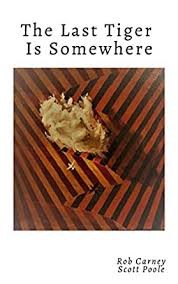
 Rob Carney is the author of seven books of poems, most recently The Last Tiger Is Somewhere (Unsolicited Press 2020), Facts and Figures (Hoot ‘n’ Waddle 2020), and The Book of Sharks (Black Lawrence Press 2018), which was a finalist for the 2019 Washington State Book Award. In 2014 he received the Robinson Jeffers/Tor House Foundation Award for Poetry. His work has appeared in Cave Wall, The American Journal of Poetry, Sugar House Review, and many others. He’s a Professor of English at Utah Valley University and writes a regular feature called “Old Roads, New Stories” for Terrain.org.
 |
 |
 |
If you like this post, please share with your writerly friends and/or follow me on Facebook, Twitter, or Instagram. You can see all the FREE resources my site offers poets/writers on my Start Here page.
Discover more from Trish Hopkinson
Subscribe to get the latest posts sent to your email.
Categories: Guest Blog Posts, Poetry/Writing Prompts, Self-taught MFA





Absolutely love Rob Carney’s poem, WHEN I WENT TO WORK AS A SNOW-GLOBE DESIGNER. Amazing!