The End. Wouldn’t it be a relief if you could just end a poem like that? Every reader would know the poem had resoundingly concluded. However, most of us would like to be more subtle with our poetic craft, to signal the end with the structure of the poem, the imagery, or the pacing of the line. We have some suggestions on how to do this.
To arrive at this list of techniques, we studied a lot of theory like Barbara Herrnstein Smith’s Poetic Closure: A Study of How Poems End—wonderful gems buried in extraordinarily dull sentences. We read it, so you don’t have to. We thought hard about how the end works in poems we admired. And we consulted friends and colleagues like Ellen Bass, Sarah Bitter, Paul Valery, Stanley Kunitz, and Joy Katz.
We think of the ends of poems as thresholds. These techniques nail them down.
- Create a poetic structure with an end point. A sonnet or other closed form is the obvious one, but you can build your own in free verse.
- Name an event people associate with ending: sleep, death, winter, homecoming.
- Use verbs with a terminal motion: falling, sinking, disappearing. Herrnstein Smith says, “There is a kinesthetic aspect to our responses, as if were subliminally, but nevertheless physically, participating in the motion so described . . .We feel in our bodies things are coming to an end.”
- Use words that mean stop: stop, over, shut, close, end, good-bye.
- End with a literal exit: a speaker walks away, drives away, walks out a door.
- Use correlative conjunctions that have an implied ending embedded in them: not only/but also, either/or, neither/nor.
- Switch tense. We usually see past to present but sometimes present to future, past to conditional, etc.
- Shift the syntax, e.g. from hypotaxis to parataxis or vice versa.
- Repeat a word or phrase, although Katz reminds us that this can be overdone.
- Use universals: all, every, none.
- Use unqualified assertions: “He tells the truth” not “I assure you he tells the truth.” Don’t use qualifiers: some, more, less, sometimes.
- Use superlatives: best, worst.
- Use a regular rhythm and mono-syllabics. Hernstein Smith says this “produces a strong, slow, and steady beat that hammers out each word distinctly and emphatically.”
- Use a penultimate line to set up the imagery for the last line. For example, if you have a cake in the penultimate line, you’ve prepared the reader for birthday candles in the last line. The closure is not as pleasant or clear if the two images don’t connect.
- Use a central image subtly through-out the poem that will come out strongly in the last line. For instance, Ted Kooser’s poem “The Last Tomato” has “one last live coal in the ashes,” “other fires,” “curly smoke,” that sets up the last line “burning, burning.”
- In an early draft if you have two consecutive stanzas on one subject, especially if the second stanza comes to a natural ending point—sleep, wake, arrive, leave. . . then separate those stanzas and move one to the end. That way the reader has the experience of seeing everything in the middle as integral to the ending image.
- And we’ll end with Kunitz’s famous dictum: “End with an image and don’t explain.”
This list is a sub-section of a much longer article. If you want hear our take on vivifying endings, the thresholds these nails are holding down, come join us here.
 Deborah Bacharach is the author of Shake & Tremor (Grayson Books, 2021) and After I Stop Lying (Cherry Grove Collections, 2015). Her work has recently appeared in Poetry East, Last Syllable, Only Poems, and Grist among many other journals, and she has received a Pushcart prize honorable mention. She is a poetry reader for SWWIM and Whale Road Review. Find out more about her at DeborahBacharach.com.
.
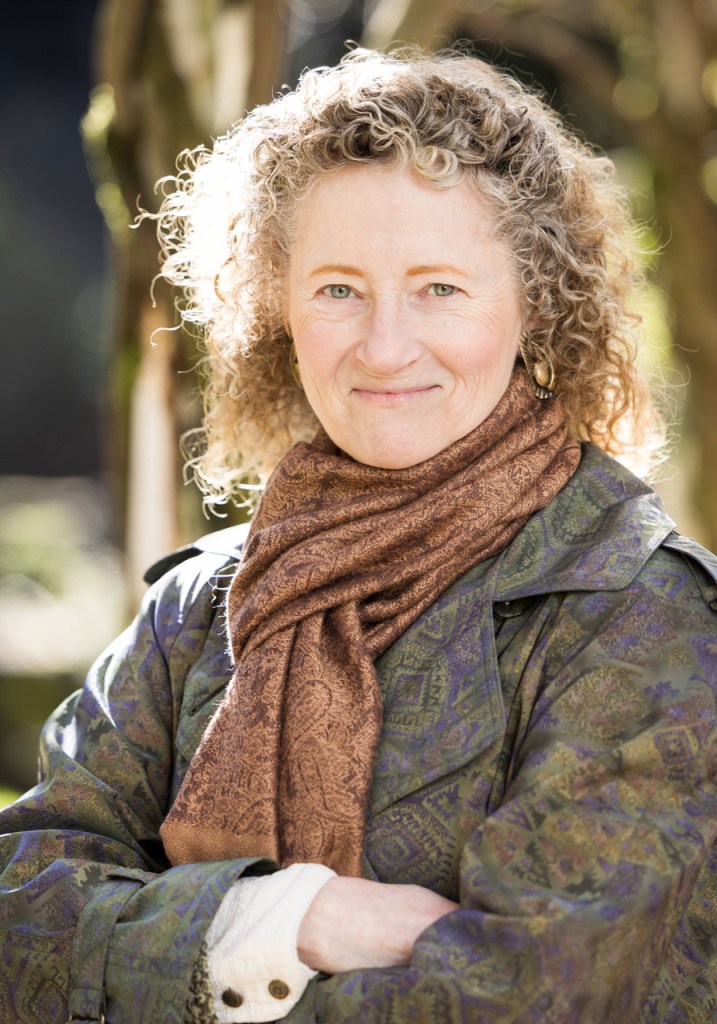 Dia Calhoun is the author of seven young adult novels, including two verse novels, After the River the Sun and Eva of the Farm (Atheneum, 2013, 2012). She has won the Mythopoeic Fantasy Award; published poems and essays in The Nashville Review, The Writer’s Chronicle; EcoTheo Review; MORIA Literary Magazine; And Blue Will Rise Over Yellow: An International Poetry Anthology for Ukraine, and others. She co-founded readergirlz, recipient of The National Book Foundation Innovations in Reading Prize and taught creative writing at Seattle University and Stony Brook University. More at diacalhoun.com.
If you like this post, please share with your writerly friends and/or follow me on Facebook, Blue Sky, or Instagram. You can see all the FREE resources my site offers poets/writers on my Start Here page.
Discover more from Trish Hopkinson
Subscribe to get the latest posts sent to your email.
Categories: Guest Blog Posts, Poetry Craft, Self-taught MFA