 When my book, The Animal at Your Side, won the Airlie Prize in 2019, it was the culmination of a seven-year submissions process in which I often wondered whether to keep going. I finished the book in 2012 and started sending it out in earnest in 2013. I didn’t track how much I submitted by book, but I did save all my submissions information in a folder in my email inbox and went through it last night out of curiosity. Here’s what I found out:
I sent out my book between 2012 and 2019–six years of rejections and near-misses for a total of 70 rejections. And that is just what came over email. I know I sent the book to a variety of snail mail contests. Sending a book out is also very costly. Most contest and open reading periods carry a reading fee of around $30. That means in any year that I sent the book to more than 10 contests, I spent at least $300 on reading fees.
What do I wish I’d known at the beginning of this process?
1. You can query presses about poetry manuscripts, and doing so is often a lot cheaper than submitting to contests.
2. Taking a long time to get published does not mean that your book isn’t good. The Animal at Your Side was a finalist at Saturnalia three times, a semifinalist in the Crab Orchard Series, and in 2018 was a finalist for the National Poetry Series.
I received nice, personal notes from editors at Dream Horse Press, Tinderbox Editions, the Brittingham and Pollack Prizes, Black Lawrence Press, Sundress Publications, New Rivers Press, and Wesleyan University Press. Many of these presses invited me to send work from the book to their journals and anthologies. It still took six years, and hundreds of dollars, to get it published.
3. If you are having financial difficulties, you can ask for fee waivers, and many presses are willing to grant them. It is a real problem that there are financial barriers to publishing. I didn’t find out about fee waivers until this year.
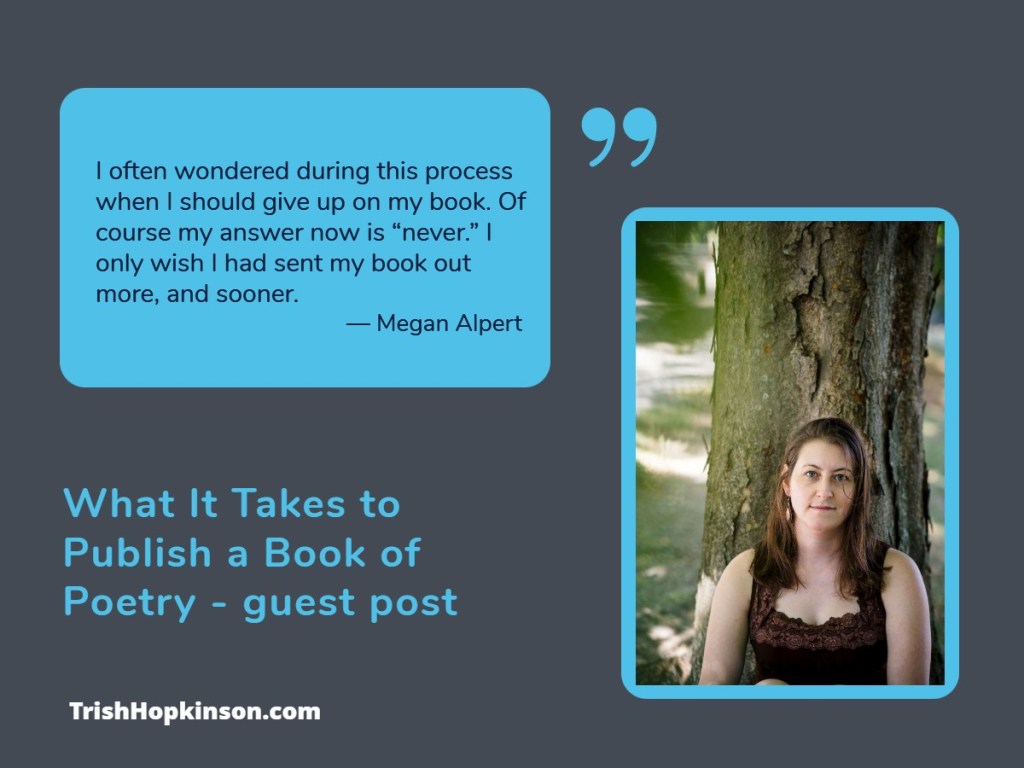
4. I often wondered during this process when I should give up on my book. Of course my answer now is “never.” I only wish I had sent my book out more, and sooner. If you are financially strapped, try to find low-cost ways to get your book considered by editors. If you are emotionally drained, seek out community to lift you up while you go through the submission process.
5. Find ways to enjoy being a writer that don’t depend on book publication. I wrote about how for the Washington Independent Review of Books in 2020.
Persistence is the most important quality you can have as a writer: the willingness to keep going, keep working, keep submitting, even when you want to stop believing in the work. If you make persistence the goal, instead of publication, you can meet your goal every year. The most successful writers you know have hundreds of rejections under their belt, even if they aren’t open about how much they’ve struggled.
Is your New Year’s resolution to send more work out? The next Submissions Jumpstart is February 18 at 3pm PST/6pm EST. Sign up here.
During the session, you’ll get a list of links to outlets that are taking submissions right now, from top tier “dream” outlets to small but mighty lit mags. You’ll have time to quickly think through a submissions strategy, get a pep talk from me, and then we’ll get to work.

 Megan Alpert is the author of The Animal at Your Side, which won the Airlie Prize and was a finalist for the National Poetry Series. As a journalist, she has reported for The Atlantic, Smithsonian, The Guardian, and Foreign Policy, where she was a fellow. More recently, she has published humor and commentary in Romper and The Belladonna Comedy. She has a short story forthcoming in The Bennington Review. Sign up for her newsletter about writing, or come submit your work at a Submissions Jumpstart event.
If you like this post, please share with your writerly friends and/or follow me on Facebook, Blue Sky, or Instagram. You can see all the FREE resources my site offers poets/writers on my Start Here page.
Discover more from Trish Hopkinson
Subscribe to get the latest posts sent to your email.
Categories: Chapbooks/Books (Press), Guest Blog Posts, Poetry Classes, Self-taught MFA