Do you ever go to the park and feel like your entire life led up to the moment of you staring a bee in the face, buzzing around a grassy shade of abyss, as the noon dust is blown from the wind and you find yourself basking in the free sunlight? Well, that’s what I’m doing right now, except the bee buzzed away; I guess it doesn’t like me.
There are so many ways to write poetry and to just write in general. I find for me that coming to the local park is one of those ways. You can blend reality into imagination and make some groovy transition. Here’s a line just wrote: “a woman beside me does yoga. / Her dog a statue breathes in the world through whiskers / and a yawn.” Let’s use some imagination and blend reality and the imaginal to get a groovy surrealist lens: “Terrier mix stares into morning, / obscures night, / dreams of ocean dancing. // Master sips Pierre glints, / smiles an empty mind. // She crashes to earth, / wet from life.”
Another trick of the trade I love to do is reading. Sometimes, I flip to a random page of a book; it could be a novel or a poetry collection or whatever. Right now, I’m in the park and deep within my black, polyester Tomtoc bag is my own book, Becoming Vulnerable. I thought I had a copy of Jean-Paul Sartre’s Nausea with me, but apparently, I don’t. I’ll make use of what I have with me; poetry is everywhere. Make use of your surroundings!
I open to page 33 at random, and see the line: “What is life but a dream of the dying sun?” then the line “Impinging on the strings of impunity” toward the bottom of the page. My eyes gaze to the end of the poem on the previous page and are anesthetized blissfully with the little “But ye have little faith.”
Why don’t we have some faith and see if we can transform some of the words in these lines to make something groovy? Perhaps we can even combine it with the lines above about the woman and her dog in the park? Remember poetry is experimentation, life and about taking risks. What have we got to lose? Let’s prove myself wrong, that we do indeed have a lotta faith!
The woman has left; she must have vanished during the interval in which I wrote the previous paragraph. Let’s use her vanishing to our advantage. The line will be: “Faith vanishes with her.” OK, so let’s create another line inspired by the words we have: “Dreams die in the sun.” Now, let’s compile before we edit:
A woman beside me does yoga.
Her dog a statue breathes in the world through whiskers
and a yawn.
Terrier mix stares into morning,
obscures night,
dreams of ocean dancing.
Master sips Pierre glints,
smiles an empty mind.
She crashes down to earth,
wet from life.
Faith vanishes with her.
Dreams die in the sun.
Now that we have the lines together, let’s critique it. The second line is long. We need to break that up. Let’s try reading it aloud and see how it sounds. Where are the pauses? “Her dog / a statue / breathes in the world / through whiskers.” OK, now we’re getting somewhere. But I don’t think “Her dog / a statue” works well. What are our options? Well, we could combine this as a single line with comma separation: “Her dog, a statue,” but that’s rather bland.
What are we trying to get across? And what can make this blandness be more imaginative? Perhaps, we can make her dog an actual statue: “Her dog-statue.” Let’s omit “her,” as it seems awkward, and let’s combine the first two lines: “Dog-statue breathes in the world.” Now the first stanza reads:
A woman beside me does yoga.
Dog-statue breathes in the world
through whiskers
and a yawn.
Terrier mix stares into morning,
obscures night,
dreams of ocean dancing.
Hmm, what if we remove “in the” in the second line? That would be much more interesting and get rid of a pesky, unnecessary article and preposition. The first line is also boring: “A woman beside me does yoga.” Let’s spice it up by making the dog-statue be the one who is doing yoga. Let’s also omit mention of “dog” and simply say “statue.”
A statue beside me does yoga.
Dog-statue breathes the world
through whiskers
and a yawn.
Terrier mix stares into morning,
obscures night,
dreams of ocean dancing.
Now, the word “does” in the first line is rather boring. We could say “yoga-ing,” but that sounds awkward, so perhaps we could combine some of the words and imagery in the first two lines to create something new. How about “A statue beside me breathes yoga?” The repetition of “breathes” is unnecessary here; let’s omit the second usage: “A statue beside me breathes yoga / the world / through whiskers.” We can remove the preposition in the second line and reduce the second and third lines into a single line by combining the concept of “the world” with “whiskers” to arrive at “world’s whiskers.” Now the first two lines read: “A statue beside me breathes yoga, the world’s whiskers.”
Let’s try replacing “statue” with “dog-statue” since we are using the term only once, and let’s also omit “beside me,” since that seems unnecessary, particularly since our main subject is an unusual object, a dog-statue. Now we have: “A dog-statue breathes yoga, the world’s whiskers.” Splitting the lines make sense after the comma. The yawning part feels like a bore, so let’s kill that. The first two lines now read: “A dog-statue breathes yoga, / the world’s whiskers.” Let’s edit the new third line of the poem by combining concepts as we’ve been doing. The third line reads: “Terrier mix stares into morning.” Let’s omit “terrier mix” because “dog-statue” is our main subject. Now the first three lines read: “A dog-statue breathes yoga, / the world’s whiskers / stare into morning” after we change “stares” to “stare” so the verb agrees with the subject (“the world’s whiskers”). Why would the world’s whiskers stare into morning? That sounds like nonsense, pure jibber jabber telekinesis. If we add the letter “u” in the word “morning,” we get a totally different concept, so what if we are dealing with mourning, with death and with permanence and impermanence, unlike a statue, which stays the same? Sounds groovy to me; let’s see what happens.
A dog-statue breathes yoga,
the world’s whiskers mourn.
See how pleasing to the eye these lines are! The lines align! The next two lines are: “obscures night, / dreams of ocean dancing.” If we change “obscures” to “obscure” and “dreams” to “dream,” then we get:
A dog-statue breathes yoga,
the world’s whiskers mourn,
obscure night,
dream of ocean dancing.
The phrase “obscure night” reeks of cliché and vagueness. However, let’s not throw it out yet. We might consider combining concepts in the subsequent line to create something interesting. Let’s analyze the line. The line “dream of ocean dancing” contains a surreal verb (to “dream”), a physical object (“ocean”) and a physical action (“dancing”). “Dancing” and “dream” are both alliterations. Now, “obscure” and “ocean” are alliterations, too. I see two viable alternatives. (I’m sure more exist.) The first would be to go for the alliteration, focusing on the double d’s:
A dog-statue breathes yoga,
the world’s whiskers mourn
dancing, dream in the ocean.
The second would be to consider combining the concept “night” with “dreams” for “nightmares”:
A dog-statue breathes yoga,
the world’s whiskers mourn.
Nightmares dance in ocean.
Our choice depends on at least a couple preferences. Firstly, do we wish to highlight alliteration or surreal flow of ideas? Secondly, we must consider rhythm.
The alliteration option seems to lose the reader, at least it does for myself, and the second option seems to subdue me in a mysterious shroud. Reading both aloud, the second option seems rhythmically preferable. So, I’ll go with that one. Our first stanza is complete.
There are three more stanzas to consider, each of which are couplets. Do we want the poems to be composed of all couplets? Does the poem take a different form than expected? These are good questions. We will see. Let’s continue editing and going through the process.
Master sips Pierre glints,
smiles an empty mind.
She crashes down to earth,
wet from life.
Faith vanishes with her.
Dreams die in the sun.
Notice how the main subject has switched to what was originally the dog owner (“master”) but now doesn’t make sense to consider as such. Let’s consider the subject as master with a capital M, as in God, Master of the Universe.
Making this perspectival switch, let’s also keep in mind the notions of permanence and impermanence we had before when we made the switch to “dog-statue.” Observe that the Master is the subject in every line except for the last: “Dreams die in the sun.” What does this line mean? Well, dreams die in the sun. They burn up. Let’s consider the significance by analyzing a little closer. Dreams are nonphysical entities; the sun is a physical entity. Dreams don’t grow old and die, but the sun does have an expiration date, despite being billions of years away.
The final line, thus, takes on an unusual logic. The nonphysical influences the physical. The relation that allows the nonphysical and physical to be held is impermanence. Let’s just say that’s the case. Now, notice the line directly above: “Faith vanishes with her [the Master].” Are we making a statement about faith or about impermanence? Perhaps, we might want to construe faith to be faith in the permanence of all things, physical and nonphysical. This is interesting; what the line really communicates is that faith in the permanence of reality disappears with the disappearance of faith in the permanence of God. In other words, God, the Master, is the center, the essence of each and every thing, nonphysical and physical; and though we have faith in the permanence of things we cannot perceive with our senses or with mentalization (“dreams” and “sun,” for instance), we might not have faith in the permanence of God, something said to be eternal, but because we cannot perceive (or perhaps we don’t have exact means by which to perceive) this something with our senses or with mentalization. To simplify incredibly, without God there is nothing. If this isn’t a final, take-away line, then I don’t know what is!
So, now we know that the last line of our poem is “Faith vanishes with her [the Master].” Next, let’s consider the line: “Dreams die in the sun.” Given our analysis above, it makes sense that this line goes immediately before the line “Faith vanishes with her [the Master].” (And might as well change “her” to “the Master” now because we’re going to eventually.) Let’s consider omitting the lines in between and do some indentations (to highlight the rhythmic flow of the poem) and arrive at the form:
A dog-statue breathes yoga,
the world’s whiskers mourn.
Nightmares dance in ocean.
Dreams die in the sun.
Faith vanishes with the Master.
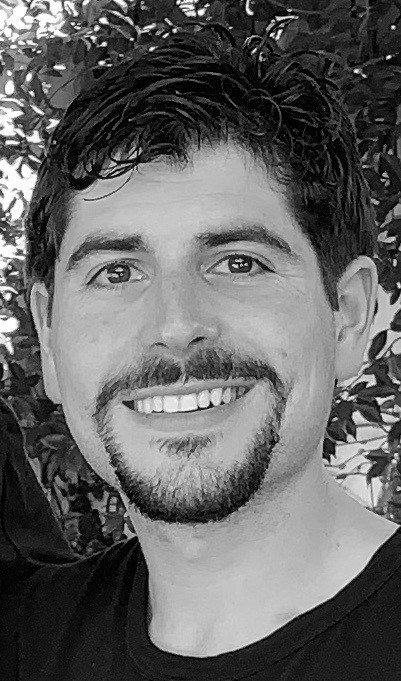 Joshua Corwin, a Los Angeles native, is a neurodiverse, 2-time Pushcart Prize-nominated, Best of the Net-nominated poet and Winner of the 2021 Spillwords Press Award for Poetic Publication of the Year. His poetry memoir Becoming Vulnerable (2020) details his experience with autism, addiction, sobriety and spirituality. He hosts the poetry podcast “Assiduous Dust,” writes for Oddball Magazine and teaches poetry at The Miracle Project, an autism nonprofit. Please visit www.joshuacorwin.com.
.
If you like this post, please share with your writerly friends and/or follow me on Facebook, Twitter, or Instagram. You can see all the FREE resources my site offers poets/writers on my Start Here page.
Discover more from Trish Hopkinson
Subscribe to get the latest posts sent to your email.
Categories: Guest Blog Posts, Self-taught MFA