Pursuing a higher education degree was an easy choice for me after undergrad. I am a scholar and will always love to learn. Looking back on when I first dived into applying for a masters program I could start the summer I graduated from college, I do remember feeling caught off-guard when I noticed some applications asked for publication experience. —What? While in a few undergraduate poetry and nonfiction writing courses, no one had mentioned the importance of publishing at all, or encouraged us students to look for places to publish what we wrote in class. I didn’t think much of it, at the time, just a quirk to work through getting into writing programs without the long publication list. Which, I did. But as I trucked through my graduate programs, I learned what was considered as writing-career-necessities — publication being a huge part of this.
While many career conversations involved the act of being published by esteemed publications, I now lament that course content lacked education on how to go about being published, or what the process of birthing a book may look like: research and agenting to get a bite for my book, and a whole lot of information which can be labeled as various forms of self and book marketing once a publisher bit.
It would be a huge benefit to writers if higher education writing programs to have courses on marketing included in the required graduation path. Even just one course that would have taught me to workshop framing my writing as an artifact which may need marketing, or even more profound, that I myself am a brand which needs marketing. I learned on my own that how I present myself online through social platforms and my website are all forms of brand marketing I present to the reading audience. I was always asked “Who is my audience?” when writing pretty much anything from poem to thesis, but no one ever put this question in the context of self-representation of myself and, well, that book I want to put out into as many hands as possible.
As a quick example, you may have noticed that writers have personalized website domains and even personal email addresses outside of large domains like Gmail. These are referred to as “Vanity email addresses.” I’ve seen advice that having your own email and website domains makes you stand out and gives publishers the impression of professionalism. I learned about vanity emails just recently, after my book was landed and the galley in progress. You probably have guessed correctly that having your own personalized email domain and website costs money. This kind of branding can only help to form that professional writer image, yet is not required.
Your money may quickly come into view for other aspects along your book journey… Such as when considering hiring an Agent. In my experience of locating a publisher for my manuscript, being a self-agent is time-consuming work. There is endless research which can be done to find a good fit for your book, like what publishers have submission fees, or specific themes, what other kinds of books they have published, etc. The list of publishers itself spans thousands of cells in a spreadsheet. First, you or an agent (should you choose this route!) will need to locate publisher websites or brick and mortar locations. You can also choose to self-publish! I did not, so I can’t speak on that topic. After you find a huge pool of possible publishers, you will research those publications to get to know them. If this sounds like a lot when you already have enough on your plate, you may want an Agent to help you. Answering the following questions has helped me navigate the agent space to narrow down which publishers I sent my manuscript to:
- Does this publisher require submission fees for consideration?
- Does this publisher print the kind of book you have produced (chapbook, experimental prose, sci-fi thriller)?
- Does this publisher’s manifesto coincide with your beliefs?
- Is the publisher going to produce artifacts or will the published product be digital?
- Do you want your manuscript published online only, print only, both?
- Do you want your published product to be available for purchase on Amazon as well as the publisher’s space?
- How much advertising will this publisher do for my book?
Fees were also a big factor in my self-agent process. Fresh out of graduate programs was not a good spot for me financially to be dishing out money I didn’t have to every publisher I admire who has a submission fee. Budget this for yourself and what you can afford to spend on submissions for the year. Now, as a senior editor of the digital magazine, Harbor Review, I understand some need to compensate the readers of submissions, and I’m not condoning that at all. I am just expressing my financial situation when I was submitting my manuscript and this was where I could not stretch my dollar. You don’t need to pay fees to get a publisher to look your way, either. It may take time but this long submission journey will pay off.
Getting an acceptance note from a publisher is a tremendous accomplishment. But the work does not stop after you sign that book contract. Many publishers you will research have varying degrees of marketing they will do on your behalf to get the book’s name out there. Some publishers will not do any at all. Some will go above and beyond. Either way, you are doing your own book marketing to some degree. How you market is dependent on your ability, your time, and even your money. Marketing can be daunting. It is still daunting for me, as I have no prior experience with marketing at all. And what is marketing for books, anyway? What does this look like?
You can buy books to get a grip on the marketing you want to do. I won’t recommend you buy a bunch of books on marketing, because I did not. The book I did read and recommend to anyone weary of marketing is Firefly Magic: Heart Powered Marketing for Highly Sensitive Writers by Lauren Sapala. I cannot recommend this marketing book enough. If thinking of marketing terrified you, pick up this book.
Besides the multiple marketing aspects, in my conversations with writer-comrades, there is one other action that we all agree we wish someone had told us in school: how royalties are determined by publishers. Getting paid by a publisher is never mentioned in programs. Payment for work is such a taboo topic in western culture to begin with, which is a different topic for a different day. However, you all need to know that publishers which set up royalties may have levels of those royalties. In general, book royalties are a ratio set on how many books are sold to how much percentage you will receive for those books sold. Most publishers pay royalties based on the retail price of the book.
I recently launched a tiny PSA on social media: “SUPPORT AUTHORS: BUY DURING PRE-SALE PERIODS” because so many readers (and writers!) do not know that advanced sales, or pre-order periods, can be a huge factor in determining that royalty level, in fact, it may be the only factor which determines your royalty percentage. This is extremely tricky to market without blatantly telling your readers that their pre-purchase will help you get a higher royalty. That your book, which is not currently an artifact which will provide the instant gratification we all crave, is the most important time to buy.
No class ever told me to write a persuasive piece about selling a book that isn’t available, yet. But I encourage you to try out this prompt. You may need to use the results of this labor to earn your own royalties, soon.
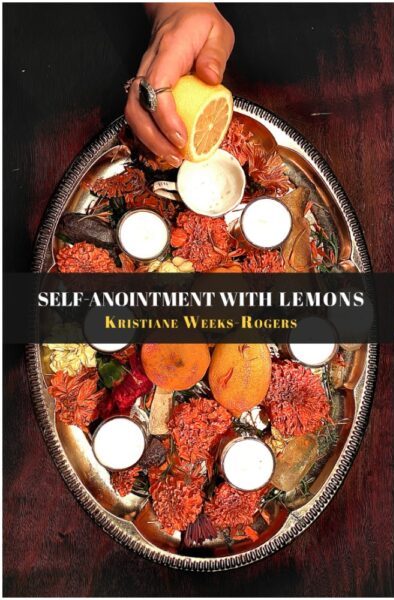
 Kristiane Weeks-Rogers (she/her/hers) is a Poet-Writer. She is the 2nd place winner of Casa Cultural de las Americas and University of Houston’s inaugural Poetic Bridges contest, an author of Self-Anointment with Lemons (Finishing Line Press, 2021) and of the chap collection Become Skeletons (University of Houston, 2018). She grew up around Lake Michigan and earned her higher education degrees in Florida (Flagler College) and Indiana (Indiana University). She earned her MFA at Naropa University’s Jack Kerouac School of Disembodied Poetics in Boulder, Colorado. She is currently a Senior Poetry Editor for Harbor Review living in western Colorado.
Discover more from Trish Hopkinson
Subscribe to get the latest posts sent to your email.
Categories: Guest Blog Posts, Poetry, Self-taught MFA

Thanks for a very informative piece. Every creative person feels the pull from actually making art to the need to show it to others and somehow usher it into the world. The process can be complex or feel more organic, but learning the process is important. So, thanks again for your addition. (I did not know about royalties and pre-orders — changes my mind completely on that subject.)