 When I first became a teacher, I was afraid of teenagers. I’d escaped high school and had no desire to revisit it. I didn’t feel brave enough or tough enough, so I started with preschoolers, imagining that a child’s first classroom would be the gentlest place to learn how to teach. What surprised me was how many truths about young children persist through adolescence—and probably beyond.
Children love to create. They want time alone and time together. They enjoy adults who aren’t their parents and often seek meaningful relationships with them. They like being read to, talking about what they hear, and making art—especially their own. They like familiar spaces that feel cozy and kind. And they like snacks. If they’re going to write, food helps.
Fifteen years later, I found myself in a high school classroom, and all those early lessons still applied. When I created a lunchtime poetry club, I realized the reasons were already in my old high school journal.
My journal was a large, denim-blue Vernon Royal Account book I carried through fields and barns near our Pennsylvania farmhouse. My grandmother sewed me a little ticking-striped knapsack for Christmas of my junior year, and the journal lived inside until I filled it in 1977. The first entry was Langston Hughes’s “Dreams,” copied from the back of an envelope sent by my summer camp counselor. I didn’t know who Hughes was, but his words told me not to let dreams die. I filled the early pages with quotes from poets—Carl Sandburg, Robert Frost, e.e. cummings, Marianne Moore—and with my own teenage urgency: “I have an immense number of thoughts and impressions going through me.”
Today’s teenagers aren’t so different. Their writing still weaves together wishes and worries, love and belonging, friendships and heartbreak. They write about trees, animals, crushes, friends, and the view from their bedroom windows. They’re quirky, funny, sincere. But their anxieties are broader: climate change, democracy, equality, survival. Their world is shaped by social media and technology in ways mine never was. They wonder what kind of world they’ll inherit.
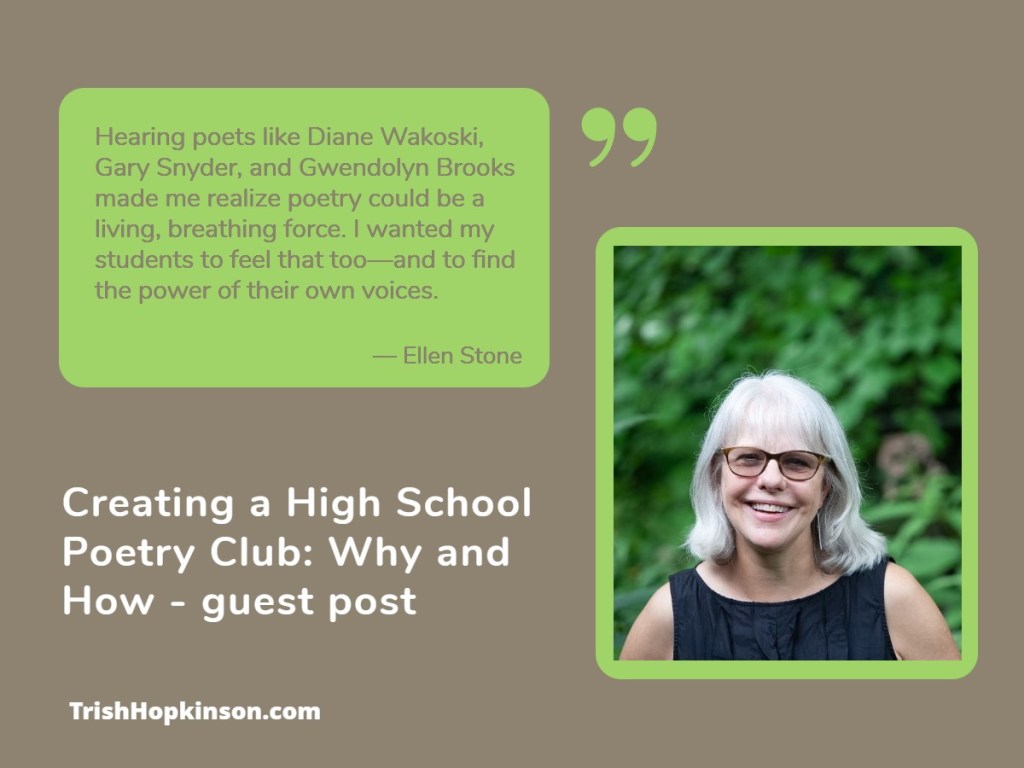
In the 1970s, I didn’t know poems could speak to my life as a young woman. I’d never heard a contemporary poet read in person. That changed in college when I discovered Diane Wakoski’s Motorcycle Betrayal Poems. Later, hearing Gary Snyder read about wildness and Gwendolyn Brooks describe love “like honey” made me realize poetry could be a living, breathing force. I wanted my students to feel that too—and to find the power of their own voices.
In 2011, a colleague and I opened our classroom once a week for Poetry Club. We advertised in the student bulletin, hung posters, and I brought homemade cookies or muffins. Our formula was simple: read a poem, talk about it, write, and share. Students came because they needed a place to write what they wanted to write in school.
I also wanted to bring in some of the magic of InsideOut, the Detroit poets-in-the-schools program founded by Terry Blackhawk. I invited local poets from the University of Michigan or visiting writers passing through town. We hosted all-school readings, performances, and a beloved event called “Shorts on the Ledge,” where students read brief pieces from a hallway ledge during National Poetry Month. We partnered with Jazz Band, Dance Body, and the annual Art Show. We read poems on the first day of school and at graduation. Whenever the school gathered, we offered a poetry prelude.
Fifteen years later, the club is thriving. In the early days, we begged for five or six students; now a dozen come regularly. We do fewer all-school events since the pandemic and the end of citywide poetry slams, but the core of our club still works. If you want to start your own, here are my top ten suggestions:
- Find a teacher-advisor. A familiar adult face matters to teenagers.
- Choose a consistent meeting space. You need desks, chairs, decent lighting, and ideally a cozy vibe. Students bring their own journals or laptops, but we offer free composition books too.
- Bring a good poem (or two) each week. I choose poems I’m excited about or browse sites like the Academy of American Poets. Visual art or intriguing objects also make great prompts. Two favorites: calendar pages in January and postcards around spring break.
- Let students shape the process. They read aloud, discuss, write, and share if they choose. They also bring poems and create prompts.
- Provide food. Snacks are a powerful draw. I bake, but parents can help if needed.
- Give students chances to perform. A school reading once or twice a year builds excitement. Our school newspaper and literary magazine often feature our work.
- Invite guest poets. They bring new perspectives and show students that poets exist in the world. Most say yes if schedules allow. We offer a small honorarium thanks to fundraising and a generous donor.
- Send follow-up emails. I share the poem, the prompt, upcoming events, and publication opportunities. It keeps students connected, especially those who miss a meeting.
- Plan occasional field trips. Museums, galleries, or bookstores make inspiring writing spaces. Our annual bookstore night, with families invited, has become a beloved end-of-year celebration.
- Be creative and share the love. We’ve hosted pre-book launches, revived an in-school poetry slam, sold Valentine poems as a fundraiser, read spooky poems at Halloween, and held a Pizza-Poetry reading in April. The Academy of American Poets offers endless free ideas, including Teach This Poem, themed poem lists, and Dear Poet.
A poetry club doesn’t need to be elaborate. It needs a room, a poem, a little food, and a spirit of welcome. Teenagers—like all children—want to create, to be heard, and to belong. Poetry gives them a place to do all three.
 Ellen Stone advises a high-school poetry club, co-hosts a monthly online poetry series, Skazat! and co-edits Public School Poetry in Ann Arbor, Michigan. Her latest collection is Everybody Wants to Keep the Moon Inside Them (Mayapple Press, 2025). Ellen’s poems have appeared recently in Third Coast, Dunes Review, Flint Hills Review, and Artemis. She is the recipient of a Good Hart Artist Writer Friends Residency. Ellen’s poetry has been nominated for the Pushcart prize and Best of the Net. Reach her at ellenstone.org.
If you like this post, please share with your writerly friends and/or follow me on Facebook, Blue Sky, or Instagram. You can see all the FREE resources my site offers poets/writers on my Start Here page.
Discover more from Trish Hopkinson
Subscribe to get the latest posts sent to your email.
Categories: Guest Blog Posts





I wish there had been a poetry club in my high school. I’d have been all over it.
Same!