 Rita Dove’s “Daystar” is one of my favorite poems, especially for the moment of building something beautiful where there was nothing before. This is how I think about both teaching and writing. In my high school English classes, I start each day by being a person with my students before I’m their teacher. I do this by asking about their weekend or their morning, by asking if anyone has anything to share and then telling stories of my own. Sometimes that moment passes quickly, but sometimes—as on the morning after the Dodgers won the World Series and a thrilled student acted out the last play to the class’s delight—this takes a while. Once, during an observation, an administrator noted it took several minutes to get class started. This led to a conversation about our differing perspectives: wasted time vs. relationship-building.
Relationships have become an important part of my writing life as well. Several years ago, Laura Passin invited me to be part of the December poets, an online group dedicated to writing a poem each day that month. We post them and offer comments—praise only, this time of year is dark enough—and this small addition to my life has made December my favorite month. I’m so grateful for this incredible community Laura has built. It has allowed the rest of us to build poems that would not exist without it, without each other. For example, when Ruth Williams noticed I was writing a whole series of form poems about becoming estranged from my childhood family, she suggested I invent a form. And I did! The rules are simple:
- The first line is also the last line. I imagined these lines as the top and bottom of a box.
- That first line also borders the left- and right-hand sides of the poem. I imagined those borders as the sides of a box.
And that’s it! Originally, I was simply going to call this a “box,” inspired in part by Jack Gilbert’s poem “Michiko Dead.” However, what I built led to Laura building a name for it—as she wrote a poem in this new form, the term “lockbox” struck her, and that felt so right to me.
Here is my first—the first!—lockbox:
Estranged Lockbox
My mother and brother find my poems about them.
My new ones, post-estrangement, that don’t feature my
mother as caretaker, folding my father’s socks, my mother
and martyrdom. Don’t amend brother (adopted) and
brother (asterisk) to brother. My mother and brother
find the poems that melt their faces into new shapes, find
my truth, which is different from theirs. They find my
poems about my brother stealing from our father, poems
about my brother shoving our mother to the ground. About
them pretending not to remember any of it. About them.
My mother and brother find my poems about them.
Even more exhilarating than inventing a form was reading other poets’ lockboxes. Several poets have written one; Laura and Courtney LeBlanc have each written two! Each one is beautiful and meaningful, and they only exist because of what we’ve all built together.
The December poets mean the world to me, and on reflecting why, I realize the group mirrors the way I teach. My students and I are a community, too. I don’t consider myself the sole imparter of knowledge; we’re collaborative. Discussion-based, not lecture-based. I have no PowerPoint, no agenda. When I assign reading, my students bring discussion questions to class, and we talk about what they find important. Every day, my students and I build something together, and it’s always a unique experience that only we could create. I can’t wait to show my students this new form I’ve built—not to brag, and not to require them to write their own lockbox or to invent their own form. To share with them about my life, as they share with me about theirs. To show them something I’ve built, and to see if it inspires them to build something of their own.
–previously published in Whale Road Review, Issue 43
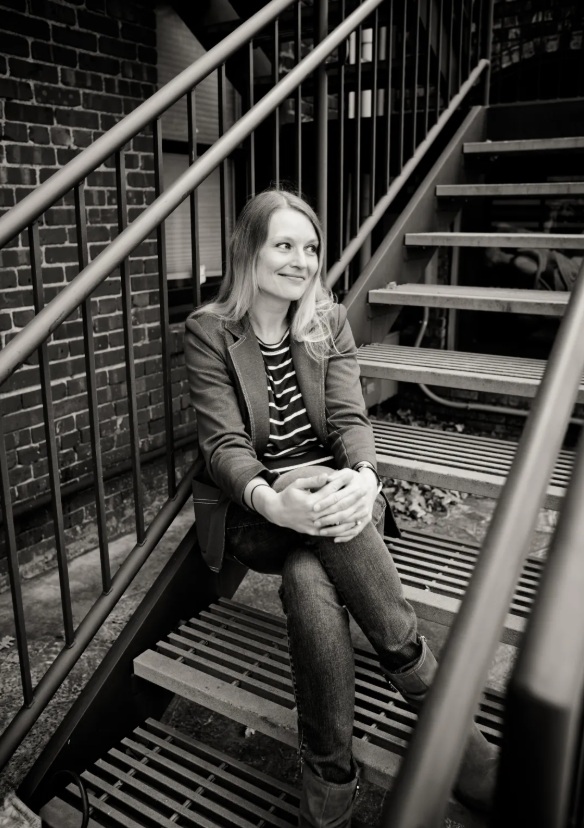
Author photo by Meryl Carver-Allmond
Melissa Fite Johnson is the author of three poetry collections, most recently Midlife Abecedarian (Riot in Your Throat, 2024). Her work has appeared in Ploughshares, Pleiades, Southern Review, Poet Lore, and elsewhere, and has received a special mention for the Pushcart Prize. Melissa, a high school English teacher, is a poetry editor for The Weight Journal for high school students, and the co-founder of a new pop culture-centered journal, Forget Cool. She and her husband live with their dogs in Lawrence, KS.
Connect with her on Instagram or Bluesky, or email her at melissafitejohnson@gmail.com! (If you have a question about Forget Cool for her or co-founder Allison Renner, please email the magazine at forgetcoolsubmissions@gmail.com.)
****
If you like this post, please share with your writerly friends and/or follow me on Facebook, Blue Sky, or Instagram. You can see all the FREE resources my site offers poets/writers on my Start Here page.
Discover more from Trish Hopkinson
Subscribe to get the latest posts sent to your email.
Categories: Guest Blog Posts, Poetry Craft, Self-taught MFA





Melissa F. Johnson wrote, “Several years ago, Laura Passin invited me to be part of the December poets, an online group dedicated to writing a poem each day that month. We post them and offer comments—praise only, this time of year is dark enough. . . .” Why do her comments depress me? Because her attitude seems to be widespread and has caused the death of poetry criticism, now given over to Pollyannaish backslapping and brown-nosing.
And I can easily write 1 crappy poem a day for a month. So what?
Interesting take Jefferson. What she’s writing about here is not about critique but of building community. There’s no argument against critique.
I hear you on the lack of criticism, generally, in the public domain, but I also know how difficult it is to offer suggestions kindly, and I think most of us don’t have that skill. But that doesn’t stop us from contributing by saying what we think worked and what spoke to us as a reader. If you don’t have anything to say except that you dislike someone’s work, or find it lacking, perhaps it’s better to have rule like that, in an open forum. I think the place for criticism is in a one on one or teaching/learning situation, where the agreement is that one is there to find better ways to write creatively, and then suggestions can be made and received. I have certainly been helped in my writing journey by critical suggestions, but those were expressly requested.
I’ll mention that while certainly there’s always more to learn, the members of this December group all have advanced degrees in poetry and have been studying the craft for decades. We’ve all had years of experience with workshops and critiques. There’s a lot of value in those systems; many of us are teachers of poetry. However, the purpose of this group is to create and support. We all find motivation with different systems. I create my best work when I feel supported and encouraged; back in my old workshop groups, I sometimes found it daunting to really let go and be wild and take risks when I suspected I’d be bringing my poem into a room where it would be ripped apart. The fact that the people in this group encouraged me to invent a poetic form and then wrote their own version of it once I did? Magic. That kind of energy makes me excited to try something new every day. As you put it, Jefferson, I too can easily write a crappy poem a day, and sometimes a crappy poem really is all I can manage during a marathon like this. But putting words to paper, making something of nothing, 31 days in a row, especially during the busy school year kind of feels like a miracle. And often we create poems that aren’t crappy at all—some are OK, some are good, and some (dare I say?) are brilliant. I’ve written poems that were total throwaways in this group, and I’ve written poems that have been picked up by places like Southern Review, Prairie Schooner, Poet Lore—places I’ve wanted to get into for years, places that rejected me when I was primarily writing for groups rooted in workshop and critique. We all have to figure out what works best for us. Hey, I invented a form! And wrote an essay about it that was just nominated for Best of the Net! I am really happy to be thriving in a positive environment. I love the people I’ve chosen to surround myself with, and the poetry life I’ve created. It doesn’t have to be for you.