 I was writing ekphrastic poems–poems inspired by works of visual or other arts–before I knew to call them that, and probably many poets reading this have done the same; after all, visual art ignites our minds and emotions, so why wouldn’t it fuel our poetry? But after I joined an ekphrastic poetry group organized by poet Laurel Benjamin, I found myself completely hooked on this approach. I started studying ekphrastic poetry, reading everything I could find, and writing, writing, writing. Almost half the poems in my second poetry book, Chasing Justice (Shanti Arts 2026), are ekphrastic! Through examples from this book, I’ll share some of the many ways I’ve discovered that artwork can be such a rich source for poetry.
My poem, “Woman and Man in Snow,” after a photograph by Fred Stein called “Embrace Paris,” began the way I initially thought ekphrastic poems would develop, and how many of mine still do. I was drawn to a work of art that moved me and started to describe what I saw. I wasn’t trying to verbally replicate the art, but rather to explore the feelings its images evoked:
In the dark street, slick and silenced by snow,
a woman and a man embrace.
Beneath a streetlight that haloes them
above their shadows. No sign
of a car, not even a stray cat stealing
a sliver of midnight
from a shivering moon…
Then questions started to arise – who are these people? What is their relationship? Imagination quickly took over.
Maybe they are hugging hello, maybe
goodbye,
with coats so thick, fingers gloved,
it must be impossible
to feel each other’s heartbeat.
Then my own experiences came bounding into the poem, arguing with that assertion:
No, more than possible. Maybe
they’re young in love and relish
the rest of the world’s loneliness.
And finally, the imagery of the art handed me a way to include the reader and finish the poem:
Have you held that moment, at least
once in your life,
when you could not have been
any warmer–
even in a blizzard so blinding
it all turned out to be a mirage?
Often, I have an idea I want to write about, but I haven’t found how to approach the poem. Then a work of art comes to the rescue! For example, one day my four-year-old grandson asked me, “What am I?” meaning race. I needed a way into the poem that didn’t feel preachy or abstract. When I saw Faith Ringgold’s painting, “Hide Little Children,” of Black and white children peering out from bushes, I realized I could ground the poem in a game of hide and go seek. Then I was finally able to write it. This has happened many times to me, and I know it has happened to other ekphrastic poets. (See Kenneth Salzmann’s fascinating discussion “Reprise: Layers of Pentimento.”) When we can’t find a way to enter a moment of grief or anger or love or wonder, a work of art may supply the visual impetus we need.
Writing poems from art can lead me down a lovely rabbit hole of researching the artist or the subject matter of the painting. Marianne von Werefkin’s painting “The Foolish Virgins” led me to the King James Bible to learn about the parable that this painting referred to, and to a poem, “Parable of the Foolish Virgins Revised,” refuting its premise. Some of the many ecopoems in my collection began with paintings or photographs of generally disdained living beings like spiders or jellyfish. The art led me to research the positive qualities of these fellow inhabitants of our earth, so I could honor them in poems like “Arachnophobia.”
When I saw Vida Gabor’s painting, “The Alchemist,” of a white-bearded old man in his laboratory in some long past century, I realized I knew very little about alchemists. Researching how they sought to use transformative powers to cure diseases and work other wonders, I found myself wishing for a modern alchemist, a woman, to fix our ailing world. This led to the poem, “Solutions”:
What we need is an alchemist, a woman
schooled to stir a beaker of woundworts
and calomel, steady it to steam, scatter
light off glass. She doesn’t need
to turn lead to gold, just melt stone
hearts down to something malleable, clay
or mud would do, pour some potion
in our ears to let us hear the hollow breath
of children who are eating dust, yes,
turn gold to bread, and guide our eyes
to see theirs in our own stained mirrors.
Straight from articles I read, I got lovely sliding-off-the-tongue words “calomel” and “woundworts” that weren’t previously in my vocabulary. Reading how alchemists tried to turn lead to gold allowed me to invert that action into our modern need to “turn gold to bread.”
I enjoy writing a poem as a conversation or argument with the artist, or as a persona poem in the voice of a character (animate or inanimate) in the art. I was introduced to these approaches by many fine poets like Jason Reynolds, who in his wonderful poem, “Charwoman Interrupted Again for Ella Watson” addresses the woman in Gordon Parks’ iconic 1942 photograph, “Government Charwoman (American Gothic). In her poem, “Encounter in the Yellow Hour,” (Under Brushstrokes, Press 53, 2015), Hedy Habra speaks in the voice of a scarecrow in the painting, “Meeting” by Gregor Ziolkowski.
In my poem, “Conversation with Henri Rousseau About His ‘Vue de Bois de Boulogne,’” I queried the artist about his choice of a focal point for the painting. This led me to working out feelings I had as a young woman on the threshold of adulthood, when I first encountered Rousseau’s work. In “Called Into the Office to Meet My First Woman Boss,” I situated myself, the speaker of the poem, right outside the frame of the painting as a woman who enters the office in Bikash Bhattacharjee’s painting, “In Her Office.”
Yet another way art influences my writing is by trying to capture the mood of the artwork through how the poem appears on the page. Again, I had remarkable poets as models, like Victoria Chang, who wrote her poem “Little Sister” in a rectangle with dots between words to channel Agnes Martin’s eponymous painting, the dots like nails, and Ilya Kaminsky, whose poem “A Walking Man” is shaped long and thin much like the Giacometti sculpture he used as inspiration.
Marc Riboud’s remarkable photograph, “Zazou the Eiffel Tower’s Painter,” shows Zazou at the top of the Eiffel Tower, balancing on one foot, paintbrush in hand. I wanted to imitate the dizziness of the photograph with the way I arranged the lines of my poem, “Worker Painting the Spire of the Eiffel Tower,” as well as through its sounds:
This bird with a brush
. .for a beak
balances
on the slight slip of the balls of his feet
. .on a slant of steel
braced by a beam
. .of sky…
Many poets have no problem populating their work with wonderful images. But for me, having art to bring visual imagery right to my doorstep is an invaluable aid to my writing. Aleksandra Ekster’s painting, “Theatrical Composition,” shows people in windows of buildings that are the set for a play. It reminded me of how as a child I used to make up stories about the people I saw in the apartments across the street through their windows. But the painting did more than jog a memory I wanted to write about. It gave me the imagery of the theater to use in constructing and eventually titling the poem:
Understudy
…
I wasn’t looking for crash of glass or passionate kiss,
not even laughter lifting off through open curtains,
just a slow-moving play, acts shuffled
between silence and solid walls,
plot ripe for imagining. Through those windows
I was understudy…
It’s been wonderful to be an understudy to the many artists whose work has inspired me, as well as to poets whose ekphrastic work I have learned from. Writing poetry for me begins with paying attention. When an artist has already framed a piece of the world through their art, they focus my attention and help me shape words that grow into new places from their visions.
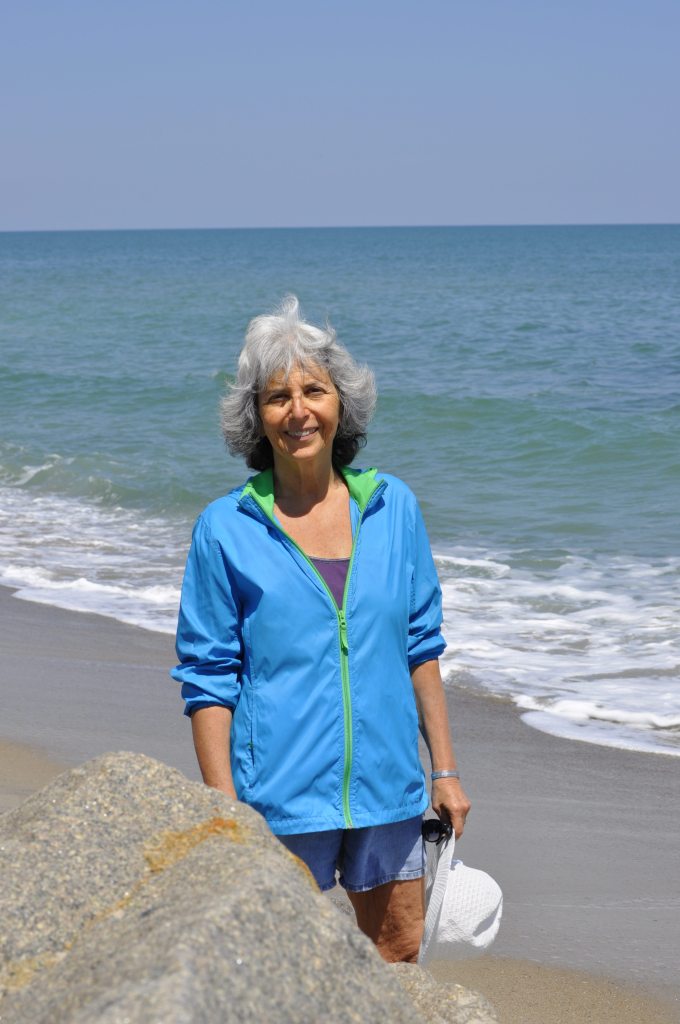 Joanne Durham’s most recent poetry book is Chasing Justice (Shanti Arts 2026). She is the author of To Drink from a Wider Bowl, winner of the Sinclair Poetry Prize (Evening Street Press 2022) and the chapbook On Shifting Shoals (Kelsay 2023). A multiple Pushcart Prize nominee, Joanne has won the Miriam Chaikin Poetry Prize, the Poetry of Louisiana’s Poetry Award, and was a finalist for the Lascaux Poetry Prize as well as many others. She teaches poetry workshops in person and online through Yellow Arrow Publishing and Maine Media. Her poetry appears widely in journals and anthologies. She lives on the North Carolina coast, with the ocean as her backyard and muse. Visit her at https://www.joannedurham.com.
****
If you like this post, please share with your writerly friends and/or follow me on Facebook, Blue Sky, or Instagram. You can see all the FREE resources my site offers poets/writers on my Start Here page.
Discover more from Trish Hopkinson
Subscribe to get the latest posts sent to your email.
Categories: Guest Blog Posts, Poetry Craft, Self-taught MFA





Joanne’s article has inspired me. I will follow her lead. Thank you.
Wonderful!
Thanks! And your poetry inspires ME!
What an inspiring post. It led me to contemplate deeply the artworks I have hanging in my house and why I love these images. And so a new poem is born inspired by a work of written art. I look forward to reading your poems in depth.
Thanks so much! A great place to start with ekphrastic poetry is the art you love in your home!